
Add us as your preferred source on Google to see more of our content in Search.
 Add to Preferred Sources
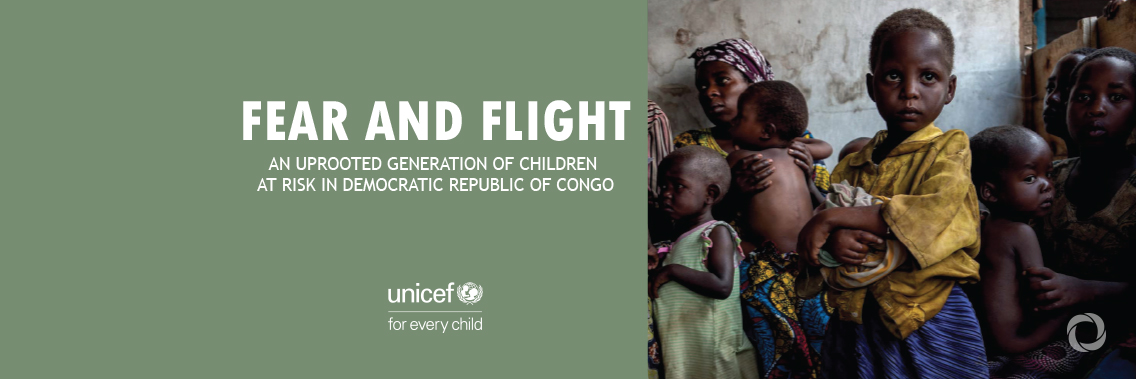
The lives and futures of more than 3 million displaced children are at risk in the Democratic Republic of the Congo (DRC) while the world is looking the other way, a report released by the UN children’s agency, UNICEF.
In the east of the country, a succession of brutal attacks by fighters using machetes and heavy weapons have forced whole communities to flee with only the barest of possessions. Entire families — including children – have been hacked to death. Health centres and schools have been ransacked, and whole villages set ablaze.
The UNICEF report calls for an end to the conflict which has fuelled one of the world’s worst humanitarian crises. UN figures show that there are currently 5.2 million displaced people in the DRC, more than in any country except Syria. Fifty percent have been displaced in the last twelve months.
Displaced families live in crowded settlements that lack safe water, health care, and other basic services. Others are accommodated by impoverished local communities. In the most violence-afflicted provinces of Ituri, North Kivu, South Kivu, and Tanganyika, more than 8 million people are acutely food insecure.
“Displaced children know nothing but fear, poverty, and violence. Generation after generation can think only of survival,” said Edouard Beigbeder, UNICEF Representative for the DRC. “Yet the world seems increasingly indifferent to their fate. We need the resources to continue helping these children have a better future.”
The report recounts the testimony of children who have been recruited as militia fighters, subjected to sexual assault, and suffered other grave violations of their rights. Such violations registered a 16 percent increase in the first six months of 2020 compared to the previous year.
Delivering relief assistance to populations who have been displaced is complex, and often hampered by insecurity and weak transport infrastructure.
A rapid response programme directed by UNICEF with national partner NGOs offers a temporary solution, providing tarpaulins, cooking utensils, jerrycans, and other essentials to nearly 500,000 people in 2020.
“These emergency distributions help deal with the immediate shock of being displaced, but they are also part of an integrated response that looks to address a family’s broader needs in health, nutrition, protection, WASH, or education,” said Typhaine Gendron, UNICEF Chief of Emergency in DRC.
However, solidarity with the DRC has shown signs of fraying. UNICEF’s 2021 humanitarian appeal for $384.4 mn is currently only 11 percent funded.