
Add us as your preferred source on Google to see more of our content in Search.
 Add to Preferred Sources
The flood-proofing drainage system in Nainhi in Mahottari built with support of UNDP, Government of Nepal and GEF has not only helped locals prepare better to withstand the rainy season, but also raised their productivity and mobility
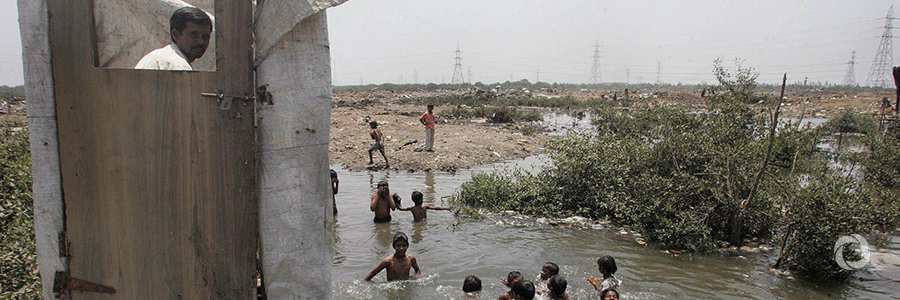
During the monsoon every year, the entirety of Nainhi VDC in Mahottari would become inundated with the overflowing waters of the nearby Ratu River. And each time this happened, residents Nainhi would be more or less cut off from the outside world until the water receded in its own time, people neither able to come in, nor go out of the village. Little wonder then that villagers dreaded this debilitating season.
Over the past two years, however, things have changed dramatically. The Community-Based Flood and Glacial Lake Outburst Risk Reduction Project (CFGORRP)—a joint undertaking of UNDP, the Government of Nepal’s Department of Hydrology and Meteorology (DHM) and the Global Environment Facility (GEF)—had teamed up with the local people to rehabilitate and construct a flood-proofing drainage system (FPDS) in the village, around about 6.6 kilometres in length. The alignment and networking of these stretches of FPDS constructed in 2015 and 2016 has been geared to allow flood water to drain from the area in a safe manner. This year, for instance, even though the rains were plentiful, and the subsequent flooding of a magnitude not seen in recent history, system worked exceedingly well to direct water away from the settlement and preventing inundation.
The FPDS passes through 0.3 hectares of farmland, out of which 0.16 is privately owned by 47 households, and which had been contributed by these families to the efforts for the sake of overall safety of the community. The land is estimated to be worth somewhere around Rs. 4 million and represents a sizeable sacrifice on the part of community members.
One of the 47 locals who contributed land, Baran Mandal, says that things have changed beyond belief in Nainhi since the FPDS was set up, and expresses his gratitude towards CFGORRP’s efforts.
“There are two main ways in which we have benefitted from the project: the first is, now we can cultivate paddy in our field even during the monsoon without fear of having the crops washed away in floods. In winter, too, the canal can be used as an irrigation channel to bring water to the farms from the river, raising the land’s productivity. And secondly, there’s the reduced risk to life and property from sudden inundation,” he explains.
Baran is also a member of the Light Search and Rescue Taskforce that forms part of the broader preparatory measures installed by the project in the area, and has acquired a range of new skills in that regard. He says: “With these taskforces in place, along with the necessary equipment, we feel more ready to withstand a disaster than ever before.”
Ramjeevan Yadav, another resident and contributor of land to the project, says that the sacrifice was worth every paisa:
“Besides the obvious problems that the floods brought, there were other issues too—health problems like diarrheal diseases would always be on the upswing during the rainy season, and we also had a lot of snake-bite cases,” he says. “And, of course, mobility during the monsoon has been eased greatly. We no longer feel walled in by the water.”
Posted on 12 October 2017