
Add us as your preferred source on Google to see more of our content in Search.
 Add to Preferred Sources
Despite initial setbacks, the EU is working hard to accelerate the internal rollout of COVID-19 vaccines. At the same time, it is already contributing in a very significant way to the global vaccination drive via exports and the international COVAX facility.
In recent weeks, the EU encountered significant difficulties in its response to the COVID 19 pandemic due to vaccine production delays. Nevertheless, the EU has done and is still doing, more than what is known in the public sphere to help vaccinate the world, and more than what it gets credit for.
Between 1 December 2020 and 15 March 2021, the EU has already exported 46 million doses to 33 countries – including those countries that have not exported any doses to anyone.
Through the COVAX facility, the EU is also already playing a key role in helping low and middle-income countries to vaccinate their population. So far, COVAX has delivered 31 million doses to 54 countries.
EU has also made a major contribution to the development of vaccines. Last year, the EU spent a lot, more than €1 billion, to support the research and development of vaccines and new therapies to cure COVID-19. The new mRNA technology, which has been vital for the rapid development of several vaccines, has been developed in Europe. The Pfizer-BioNTech vaccine in particular has been strongly supported by the EU.
Through the advance purchase agreements (APAs), the EU has ordered 1.3 billion vaccine doses from BioNTech/Pfizer, Moderna, AstraZeneca, and Johnson & Johnson. That is significantly more than what needed to vaccinate 447 million people. And as confirmed by the European Council on 25 March, the EU intends to share part of these vaccines with the partner countries in parallel to accelerate the EU’s own vaccination plans.
“We intend to share part of the vaccines we have ordered with our partner countries in parallel to accelerating the EU’s own vaccination plans.”
As things stand, 360 million doses should be delivered to the EU in Q2 (compared to 100 million in Q1). Should this target be fulfilled, it will conduct to having 70% of the EU adult population vaccinated by the end of the summer. This in turn will help expand assistance to the rest of the world.
There is a lot of pressure on suppliers, in particular AstraZeneca, to meet their commitments and deliver the contracted volumes to the EU. On 30 January, the Commission introduced a transparency mechanism for exports of COVID-19 vaccines to the rest of the world to help check that companies respect their commitments with the EU.
It is indeed important to stress that the whole world needs to be vaccinated rapidly. Faced with the COVID-19 pandemic, no one is safe until everyone is safe. This is more than a catchphrase: it is a basic truth. As the virus continues to spread, other variants are emerging. It is a race against time, as we must be faster with vaccinations worldwide than the virus with its mutations. We must do so for reasons of basic solidarity, but also out of self-interest.
No one is safe until everyone is safe
This conviction has been at the heart of EU actions since the beginning of the crisis. Last year, the EU joined forces with the World Health Organization and other international health actors to create COVAX. Through COVAX, high-income countries and other donors are paying for vaccines that will be delivered for free to 92 low-income countries.
“The EU has been the largest donor to COVAX until very recently – and without us, it would not be able to do its remarkable and necessary work.”
The European Union, with its Member States, the European Investment Bank, and the European Bank for Reconstruction and Development, have so far provided €2.2 billion to this initiative, including €1 billion from the EU budget.
The choice of multilateralism
This choice is fully in line with the EU’s general commitment to multilateralism. However, in terms of vaccine diplomacy, this is a weakness for Europe, compared to other vaccine donors: it is not the European flag that is present on vaccine deliveries but that of COVAX. The EU is the major driver behind the work of COVAX, but it does not get the diplomatic recognition that the countries using bilateral vaccine diplomacy do get. This is not the first time in global affairs and the EU needs to sharpen its communication efforts.
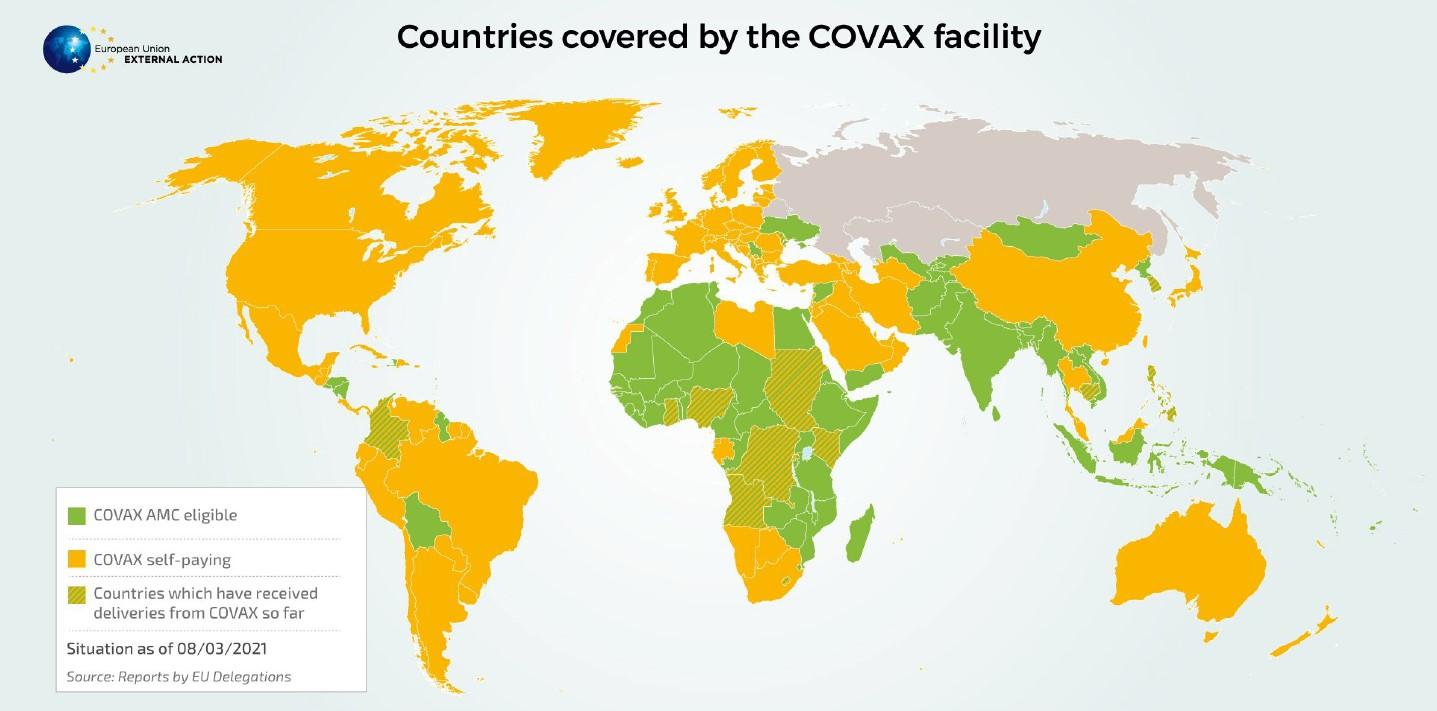
The initial objective of COVAX is to ensure at least 20% vaccine coverage across the world, beginning with health workers. Depending on further donations from participating countries, COVAX can and will be expanded in scope and ambition. 31 million doses have already been delivered by COVAX until 22 March to 54 countries like Sierra Leone, Tajikistan, Mozambique, Mali, Malawi, Nepal, Uganda, Fiji, Cambodia, Nigeria, Angola, Côte d’Ivoire, Ghana, Yemen, Albania, Colombia.
COVAX needs significant additional funding
However, to fulfill its mission, COVAX needs significant additional funding. Last February, the EU doubled its own contribution with €500 million additional support and Germany pledged €970 million. Against this background, the EU warmly welcomes the US’ announcement to join COVAX and give a contribution in 2021 and 2022 of up to 4 billion USD. This will be a welcome boost for ensuring global vaccination.
In addition, it should not only deliver vaccines to low and middle-income countries but also support effective vaccination campaigns. With the donors’ help, including from the EU, COVAX will provide financing to support the planning, technical assistance, and cold chain equipment to help prepare for the delivery of vaccines around the world, beyond the 92 low and middle-income countries supported by COVAX.
High expectations on the EU
In conclusion, the EU is aware that the world has very high expectations of its contribution to vaccination campaigns. The production capacity is in continuous development and it is expected to further strengthen deliveries and technical support to the partners in the coming weeks. Assistance will be geared, especially to low and middle-income countries.