
AFD and the World Bank are supporting Serbia's Green Agenda through two new programs for a total of €234 million
Add us as your preferred source on Google to see more of our content in Search.
 Add to Preferred Sources
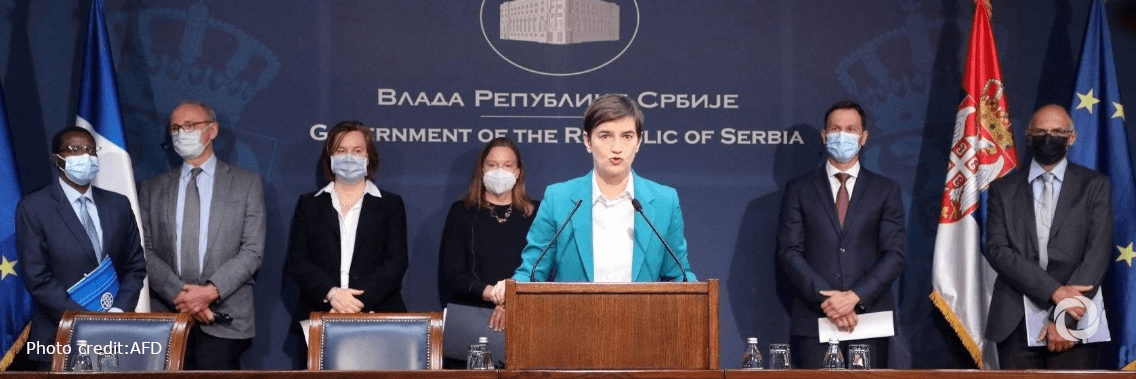
The public policy loans in support of green recovery, as well as the support program for the modernization of the railway sector, were signed on May 10 at the premises of the government of the Republic of Serbia.
The credit facility agreements were signed by Mr. Sinisa Mali, Minister of Finance, the French Ambassador to Serbia His Excellency Mr. Jean-Louis Falconi, the Regional Director for Eurasia of Agence française de développement ( AFD) Ms. Cécile Couprie, as well as the Director of the World Bank for the Western Balkans Ms. Linda Van Gelder. Prime Minister Ana Brnabić also joined the ceremony.
The first loan, co-financed by the International Bank of Reconstruction and Development (IBRD) with 82.6 million euros and AFD with 50 million euros, is based on two pillars: improvement of efficiency and transparency of the public sector and initiative of green growth.
The second loan is related to the development of the railway junction with a total value of 102 million euros, and the World Bank and AFD are financing the project in partnership, with 51 million euros each.
Prime Minister Ana Brnabić stressed that these are very advantageous loans that fully cover areas whose progress is a priority for Serbia in the coming years.
“We will succeed in improving Serbia’s resilience to future climate change risks and urgently address the challenges of air pollution. In addition, further improvement of the work of the public sector and its transparency will be made possible, and funds will be provided for the improvement of the railway sector in Serbia. Therefore, green recovery, further improvement of the work of the public sector and its transparency, as well as the renewal of the railway infrastructure are the three key elements of these loans,” said the Prime Minister.
She recalled that by signing the Sofia Declaration on the “Green Agenda” for the Western Balkans, Serbia committed to implementing measures in the field of climate change and pollution prevention, energy and biodiversity development, mobility and circular economy, sustainable agriculture, and food production.
“It is up to us to work on reducing carbon dioxide emissions, developing market models for the use of renewable energy sources, as well as reducing the use of coal. With this year’s budget rebalancing, we have increased the allocations for ecology compared to the original budget from 16 billion dinars to 24 billion dinars. The increase in the budget is proof that we are serious about this intention,” said the Prime Minister and added that Serbia must follow Europe and its agendas related to climate change.
“The World Bank Group is supporting Serbia in its commitment to transition to a green economy, more efficiently utilize energy resources and build resilience to climate shocks, while supporting growth, employment, and eliminating poverty,” said Linda Van Gelder, World Bank’s Regional Director for the Western Balkans.
“The two loans in partnership with the French Development Agency are designed to assist the Government in its endeavor to enhance the sustainability of the Serbian economy and regional connectivity, both of which are critical to Serbia’s path to greater prosperity and to accession to the European Union,” she added.
“These two first financings of AFD in Serbia are part of France’s broader approach to supporting Serbia’s ambitions and commitments in terms of climate change, environmental protection, and green infrastructure development, in line with Serbia’s European perspective. These projects reflect and contribute to the reinforcement of bilateral relations between our two countries, supported by the highest authorities of the State,” said H.E. Jean-Louis Falconi, Ambassador of France to the Republic of Serbia.
Cécile Couprie, AFD’s Regional Director for Eurasia, is delighted with the signing of these two important programs, which are the result of a fruitful strategic and operational dialogue established with the Serbian authorities to support climate action policy reforms and the development of key green infrastructures, in tandem with the World Bank.
“This initiative demonstrates AFD’s ability to provide concrete and suitable support to Serbia for accelerating its EU integration agenda, and fostering a sustainable development pathway compatible with the SDGs and the Paris Agreement on climate change. We will continue to invest vigorously in the coming months and years on these key issues in Serbia and in the region, through all the financing and technical tools offered by AFD Group,” said Cécile Couprie, AFD’s Regional Director for Eurasia.