

Add us as your preferred source on Google to see more of our content in Search.
 Add to Preferred Sources
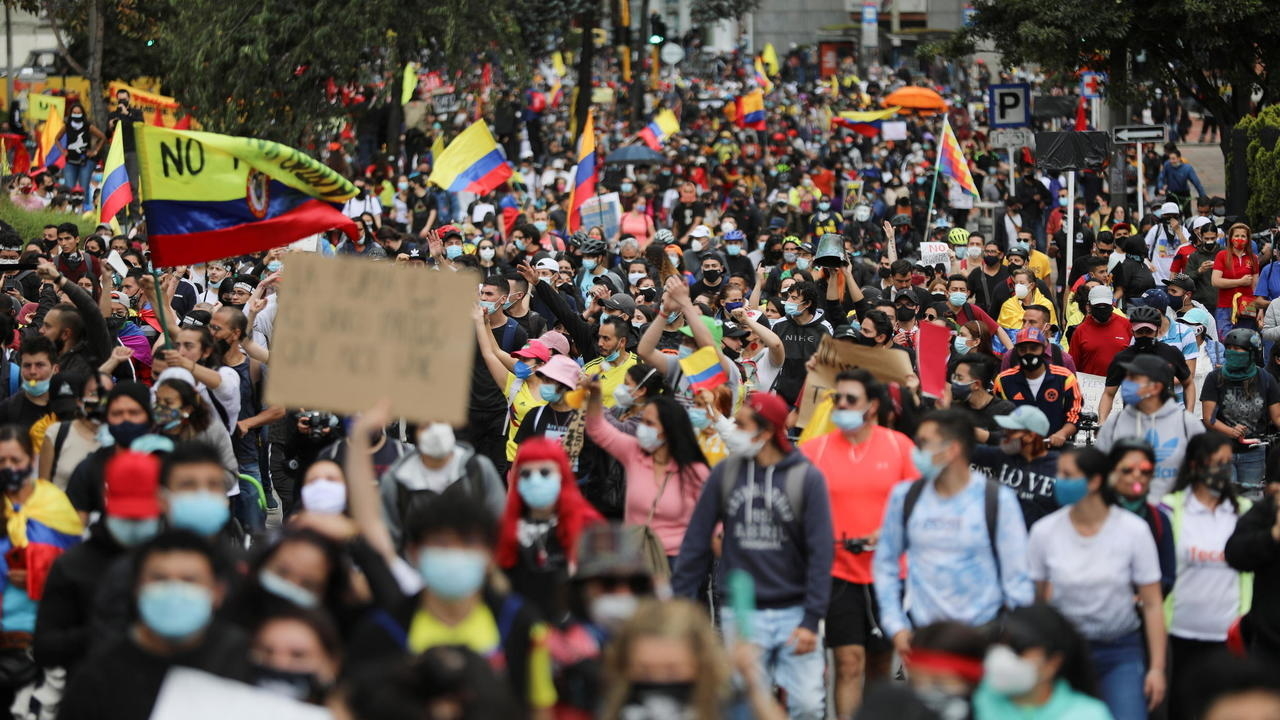
Tens of thousands of Colombians have joined the waves of protests that have been spreading all over the country since late April. The protests that began on 28 April, sparked by inequality and poverty issues, have grown increasingly stronger since then because of police brutality which has led to the death of over 40 people.
Colombia’s economy has been badly hit by the ongoing COVID-19 pandemic with the country seeing its GDP falling by 6.8% in 2020, the biggest decrease in half a century. The economic downturn has caused a drastic growth in poverty levels as many people have lost their source of income. Data from the Administrative Department of National Statistics (Dane) shows that 42% of Colombians, or 21.02 million people, are affected by poverty, exceeding the figure in 2019 by 6.8%. Of these, 7.47 million live in extreme poverty, an increase of 5.4% against 2019.
What sparked protests?
“The level of economic distress is enormous. Like the rest of Latin America, Colombia has been hit hard by the pandemic and as a result, we have had to live with a year of on-and-off lockdowns,” said Elizabeth Dickinson, a researcher with the International Crisis Group (ICG).
Against this background, people’s anger was triggered by a tax reform bill proposed by President Ivan Duque’s government which aimed to raise taxes in order to stabilize the country’s financial situation. The government expected to raise about US$6.3 billion in additional revenue following the reform although this proposal encountered strong opposition from society, with 80% of Colombians opposing it.
What of evolutions?
The reform that was proposed amid raising levels of poverty forced thousands to take to the streets with protests having continued since 28 April despite the fact that the President withdrew the reform bill on 2 May.
The most brutal and bloody clashes took place in the third-largest Colombian city of Cali where the protests spread over both urban and rural areas. As a local human rights ombudsman, Carlos Camargo Assis, reported, police used “excessive force”, killing 42 people with hundreds more injured including 849 police officers. This means that the current protests are the bloodiest since 2016 when Colombia managed to sign a peace agreement with the communist guerilla group, FARC, putting an end to decades of civil war.
International reaction
The UN condemned the police brutality calling for a halt to the bloodshed.
“We are deeply alarmed at developments in Cali overnight, where police opened fire on demonstrators, and a number of people were killed and injured. We express our profound shock at the events there and stress our solidarity with those who have lost their lives, as well as the injured and their families”, said Marta Hurtado, a spokesperson for the UN human rights office (OHCHR). “We stress also that law enforcement officers should abide by the principles of legality, precaution, necessity, and proportionality when policing demonstrations. Firearms can only be used as a measure of last resort against an imminent threat to life or of serious injury,” the spokesperson added.
Amnesty International, a global human rights organization, echoed this, saying:
“The Colombian authorities must promptly, independently, and impartially investigate all allegations of excessive and unnecessary use of force against demonstrators, which has resulted in dozens of people being killed and injured, arbitrary detentions, acts of torture and sexual violence, and reports of people disappearing.”