

Add us as your preferred source on Google to see more of our content in Search.
 Add to Preferred Sources
5 key reasons to read this article
- World leaders promised to rebuild a futuristic Gaza. But what does that mean for families still living under canvas roofs?
- Billions were pledged in Washington to undertake the work, which will take years. But where will the displaced Gaza residents live in the meantime?
- A new reconstruction body now controls Gaza’s future. Yet, it reports to almost no one.
- The plan promises jobs, homes and stability, but critics warn it could reshape Gaza without its people.
- Behind the silver-tongued speeches lies one unanswered question: will this plan rebuild Gaza or will it reshape it instead?
Standing outside her tent in Gaza as the new year began, Umm Rabee’ Al-Malash had one message for the world. “The Palestinian people must be supported, as they have endured immense suffering,” she told a United Nations correspondent. Help us rebuild the Gaza Strip, bring about peace, and allow us to live in peace and security.”
On 19 February, more than two dozen world leaders gathered at the newly renamed Donald J. Trump United States Institute of Peace in Washington. They pledged billions, promised gleaming towers, and unveiled a ‘New Gaza’ of waterfront promenades.
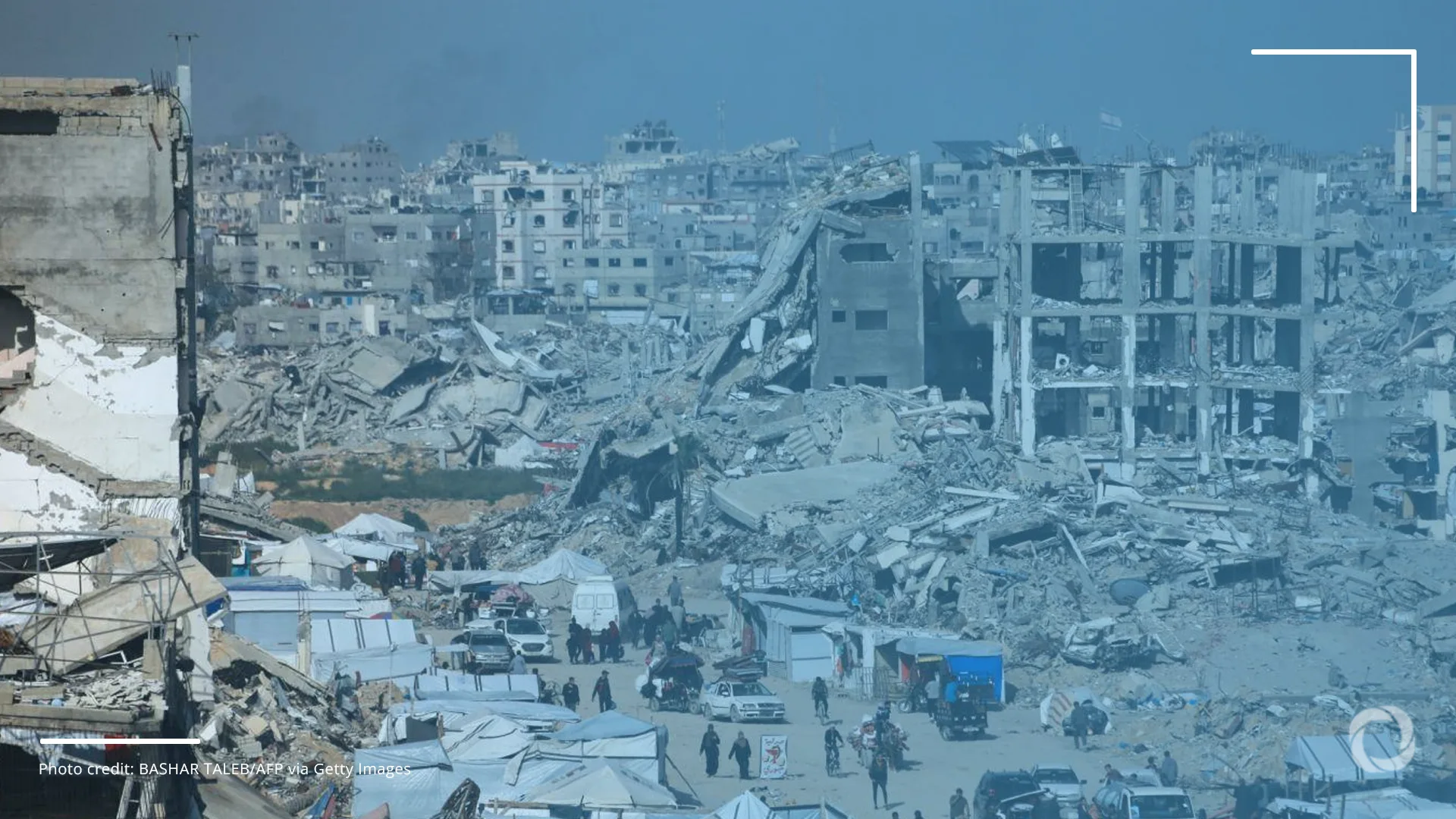
Umm Rabee’ had no electricity to watch this. Her tent, and the tents of 1.5 million others, remained. The central question is no longer whether the vision is grand enough. It is whether and when it reaches people like her.
Roofs, hospitals, schools, and the arithmetic of ambition
Apollo Global Management’s Marc Rowan, a member of the Gaza Executive Board, announced plans to begin in Rafah with 100,000 homes for 500,000 residents, backed by US$5 billion in infrastructure. The full proposal promises 400,000 homes, US$25 billion in wider development, 200 schools, and 75 medical facilities. Board member Jared Kushner has said construction could be completed in two to three years. No timetable has been confirmed. No contractors have been named.
The scale of the destruction exceeds the scope of any blueprint yet produced. More than 80% of Gaza’s buildings have been damaged or destroyed. Sixty-one million tons of debris blanket the strip. The United Nations estimates reconstruction will cost roughly US$70 billion. Clearing the rubble alone could take until 2032, while full rebuilding may stretch to 2040 even under ideal conditions, according to a United Nations Development Program report.
Against this backdrop, confirmed pledges total US$17 billion, with US$10 billion from the United States and US$7 billion combined from nine other member states. The funding gap is structural, not marginal.
For architect Ali A. Alraouf, the vision itself is part of the problem. Kushner’s images of glass towers and marinas represent what he calls the “Vegas-ification” of Gaza, “gated communities designed for a specific economic class, rather than an organic city fabric that serves the local population”.
Crucially, no details have been provided regarding where hundreds of thousands of displaced Palestinians will live during the two-to-three-year construction window. No detailed interim housing plan has been provided.
Legal scholar Dr. Youssef Jabareen noted that lengthy disruptions to homes and communities can make emigration appear to be increasingly rational. In that sense, time itself may become a political factor.
However, Rowan framed Gaza’s redevelopment as an opportunity to “unlock and finance” economic value in the territory.
Who is watching the watchmen?
The Board of Peace operates outside traditional UN procurement structures, raising questions as to its transparency and accountability.
See also: Peace by transaction: How Trump’s Board of Peace is testing the global diplomatic order
Slovenia, during last year’s Security Council meeting, called for “clear terms of reference,” stressing the need for transparency and good faith. Neither demand was addressed at the recent pledge-focused gathering.
Safia Southey, a researcher and consultant specializing in post-conflict justice, has raised the legal concern that the resolution establishes no criteria for Board appointments, no guarantee of Palestinian representation, and no mechanism for UN oversight.
The plan, she argues, raises core questions about whether the Security Council can re-engineer governance in an occupied territory “without the consent of the people concerned.”
The European Council on Foreign Relations has warned that concentrated control risks “profiteering and graft.” This caution is historically grounded. Centralized reconstruction in Iraq generated waste and instability, while Bosnia’s multilateral approach produced more enduring results.
While critics note the lack of UN oversight, a U.S. official at the Security Council called the Board a “board of action,” stating that “old structures were not working” and highlighting its potential for faster, more coordinated reconstruction.
World Bank President Ajay Banga announced that the Bank would manage donor funds under “strict financial, legal, and monitoring standards,” a meaningful step, but one that does not resolve the deeper governance issue.
Will Gazans rebuild Gaza?
The plan has been put together, as Al Jazeera commented, without input from Palestinians in Gaza. There is no commitment to prioritize Palestinian construction firms, no guarantee that the anticipated jobs will go to local workers, and no mechanism to channel contracts into Gaza’s battered private sector.
However, board member Naty Gabay confirmed that Gazans would be at the center of construction, generating jobs and helping to resuscitate the local economy.
The Business and Human Rights Resource Centre has insisted that genuine reconstruction must channel contracts through local companies and guarantee living wages under enforceable standards. Without that, rebuilding risks becoming a short-term construction boom that enriches foreign companies while Gazans remain laborers in their own cities.
The exclusion of women is compounding concerns. An ActionAid Palestine report found that women-led organizations are routinely sidelined in post-conflict planning. Buthaina Sobh, Director of the Wefaq Association for women and childcare, explained “the same mistakes” were being repeated.
Soldiers in the street
Several countries have pledged troops to the proposed International Stabilization Force, with Egypt and Jordan training a Palestinian police force.
For civilians, a foreign military presence represents a double-edged sword. The ISF’s mandate includes civilian protection and humanitarian facilitation, urgent needs that remain dangerously unmet. Israel has averaged fewer than 150 humanitarian trucks per day under the ceasefire, against a target of 600.
Yet Southey’s analysis notes that Resolution 2803, which authorized the Board of Peace, reportedly imposes no specific obligation on Israel to facilitate access. The responsibility rests with the Board, not with Israel.
The structural limits go further. Reports indicate ISF troops may be confined to a “green zone” on the western side of Israel’s yellow line, leaving the areas with the greatest need outside their operational reach.
A recent survey found that 69% of Palestinians oppose the disarmament that is the force’s central task, meaning that ISF will arrive in a territory where most of those it is intended to protect reject its primary purpose.
Meanwhile, Indonesia’s government has argued that a multinational security presence under the Board of Peace could help to maintain stability and support a peaceful transition in Gaza.
Meanwhile, peace operations experts Cedric De Coning and Erik Skare have warned that without a political end-state, the force risks becoming “a proxy occupation with no exit date”.
No plan B
At Davos, when asked what would happen if funding fell short, Kushner replied, “There is no Plan B.” With US$17 billion pledged against the at least US$70 billion required, that assertion underscores the fragility of the enterprise.
Israeli PM Benjamin Netanyahu has stated there will be no reconstruction without demilitarization. Hamas has signaled willingness to disarm only in exchange for a verified Israeli withdrawal and credible progress toward statehood. Neither condition currently exists.
David Makovsky and Dennis Ross of the Washington Institute for Near East Policy frame the dilemma more clearly. If disarmament and reunification occur, the plan may take root. If not, Gaza risks renewed partition or renewed war.
The long wait
Gaza’s economy, once valued at US$2.8 billion annually, has shrunk to US$362 million. The Board of Peace promises to raise GDP to US$10 billion by 2035 and deliver a rebuilt Rafah within three years.
Umm Rabee’ Al-Malash did not ask for a GDP projection. She did not ask for a special economic zone. She asked for a roof and peace. That is the least that two million people are waiting for.