
Add us as your preferred source on Google to see more of our content in Search.
 Add to Preferred Sources
5 key reasons to read the article
- For the first time in 80 years, someone is building a parallel world order in plain sight.
- What was intended to be a Gaza ceasefire mechanism has become a test case for a new global order.
- The world could be witnessing an experiment in whether money and power can replace multilateral rules.
- A US$1 billion entry fee could reshape who gains a voice in world diplomacy.
- If this model works once, it could be copied everywhere.
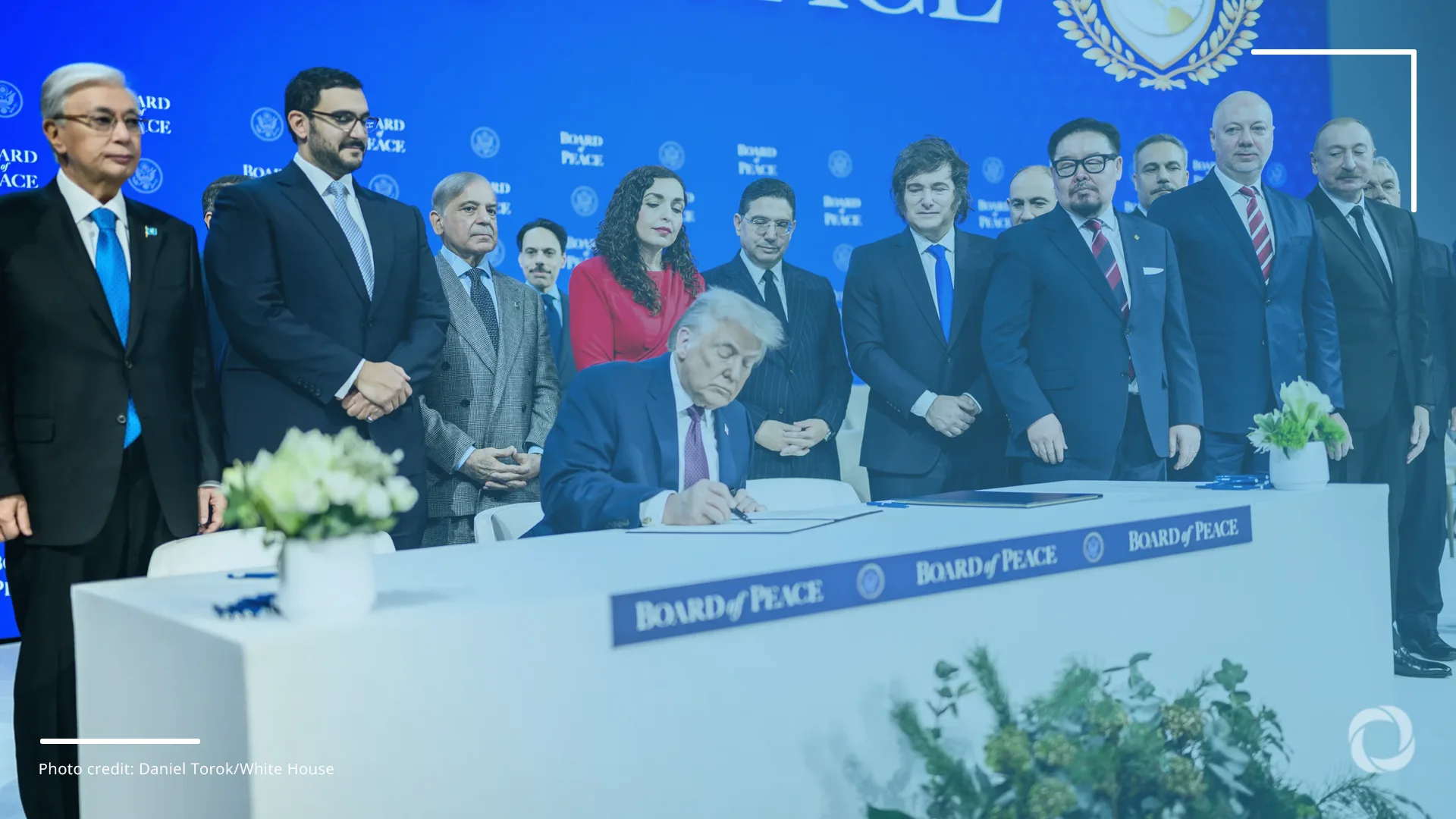
Donald Trump’s loudly trumpeted Board of Peace (BoP) began as a Gaza-focused mechanism to manage the enclave’s post-war transition. Within days, Trump recast it as a US-led peace body with global ambitions, with experts warning that he was testing whether a transaction-based coalition could grow into a parallel system of diplomacy operating outside the United Nations.
The proposal comes after months of Security Council paralysis over Gaza, where repeated US vetoes blocked ceasefire resolutions even as the humanitarian crisis deepened. Trump’s team now cites this dysfunction as justification for circumventing the UN.
As of 21 January 2026, around 25 countries had reportedly signed up, mostly from the Middle East and Asia. China and India have been invited but have not confirmed their participation. Russia has stated it is considering it. Argentina is the only Latin American country among the BoP members. Most EU countries have either rejected it or requested more time for deliberation whereas Hungary and Bulgaria have joined.
Regardless of whether the board’s plans materialize, it has exposed deeper tensions about how peace can be achieved in the 21st century, and who gets to make it.
From Gaza to global: Legal mandate vs Trump’s ambitions
In November 2025, the UN Security Council adopted Resolution 2803, authorizing the BoP to oversee Gaza’s post-war transition under a temporary mandate that will run until the end of 2027. Under the document, BoP must report back to the Council on Gaza every six months and any extension of its mandate would require a new ruling by the UN Security Council.
Legally, that is the full extent of its authority. Everything else exists in political ambition alone. And that ambition is huge. Trump has promoted the board as being a much bigger, permanent body which, he argues, could act where United Nations processes have been seen to be slow or ineffective. In his own remarks, the UN has not been “very helpful” in settling major conflicts.
The US$1 billion club: Who holds the cards
Under the board’s leaked charter, which does not mention Gaza even once, permanent membership requires a US$1 billion contribution in the first year of joining. This turns the board into a ‘pay-to-play club’ of the wealthy and geopolitically aligned rather than being a representative institution. For many Asian and African countries, the fee exceeds entire annual budgets for diplomacy or disaster relief, effectively excluding them from the system.
According to the draft charter, decision-making is heavily centered on the chairperson, a role Trump is designated to hold and without a fixed term. He will have veto power over all the board’s decisions and the right to appoint his own successor, a level of centralized control unprecedented in international institutions. Trump has already displayed his confrontational style when he threatened France’s President Emmanuel Macron that he would “put a 200% tariff on his wines and champagnes” if he refused to join the BoP.
International observers warn this state of affairs could reinforce existing power asymmetries and marginalize smaller states and the Global South.
Slovenia’s Prime Minister, Robert Golob, stated his country would not join because the initiative “dangerously encroaches on the broader international order” established under the UN Charter, which enshrines legal equality for all member states.
A rival or a puppet? The board vs. the UN
Trump has hinted that the board could grow beyond its current mandate, saying that “once this board is completely formed, we can do pretty much whatever we want to do”. At the same time, he insisted that although “the UN hasn’t been very helpful” in solving conflicts worldwide, “you’ve got to let the UN continue”.
Diplomats and experts comment that in practice this tension points to the risk of the UN being gradually sidelined.
Robert Wood, a former US Deputy Ambassador to the UN, has warned that most member states would oppose any attempt to sideline the organization, as reported by CNN. Tom Fletcher, the UN’s humanitarian chief, has been blunt stating that the organization “isn’t going anywhere”.
Professor of International Law, Aurel Sari, told Euronews that while states are free to create new organizations, they cannot use these to bypass their existing legal obligations. The BoP cannot assume global authority without new legal mandates from the UN Security Council or through new international agreements, he explained.
On the other hand, legal expert, Eliav Lieblich, recalled that Trump and his administration “do not particularly respect” international agreements, with the USA’s latest withdrawal from 66 bodies proving this. He noted that if many states join the board, “this could pose a challenge to the UN”.
Foreign affairs expert Robinder Sachdev argues that if the board succeeds where the UN has failed, it could signal the “end of the United Nations’ system”.
Accountability on trial
For now, the BoP is legally a Gaza-only, time-limited UN tool. Politically, its authors’ ambitions are far bigger. It appears to be a test case for whether global diplomacy can be reorganized around power, money and leverage as opposed to the core of the UN multilateral system that is based on human rights, development, peace and security.
Human Rights Watch acknowledged that “the UN system has its problems”, but still warned that it is better than Trump’s “global Politburo”.
Recent history highlights the risks. When major powers bypassed the UN over the 2003 Iraq invasion, it weakened norms that later crises then exploited. Russia has repeatedly cited NATO’s Kosovo intervention, conducted without Security Council authorization, to justify its military actions in Georgia and Ukraine. Peace talks on Afghanistan excluded women’s organizations, with catastrophic consequences when the Taliban returned.