

Add us as your preferred source on Google to see more of our content in Search.
 Add to Preferred Sources
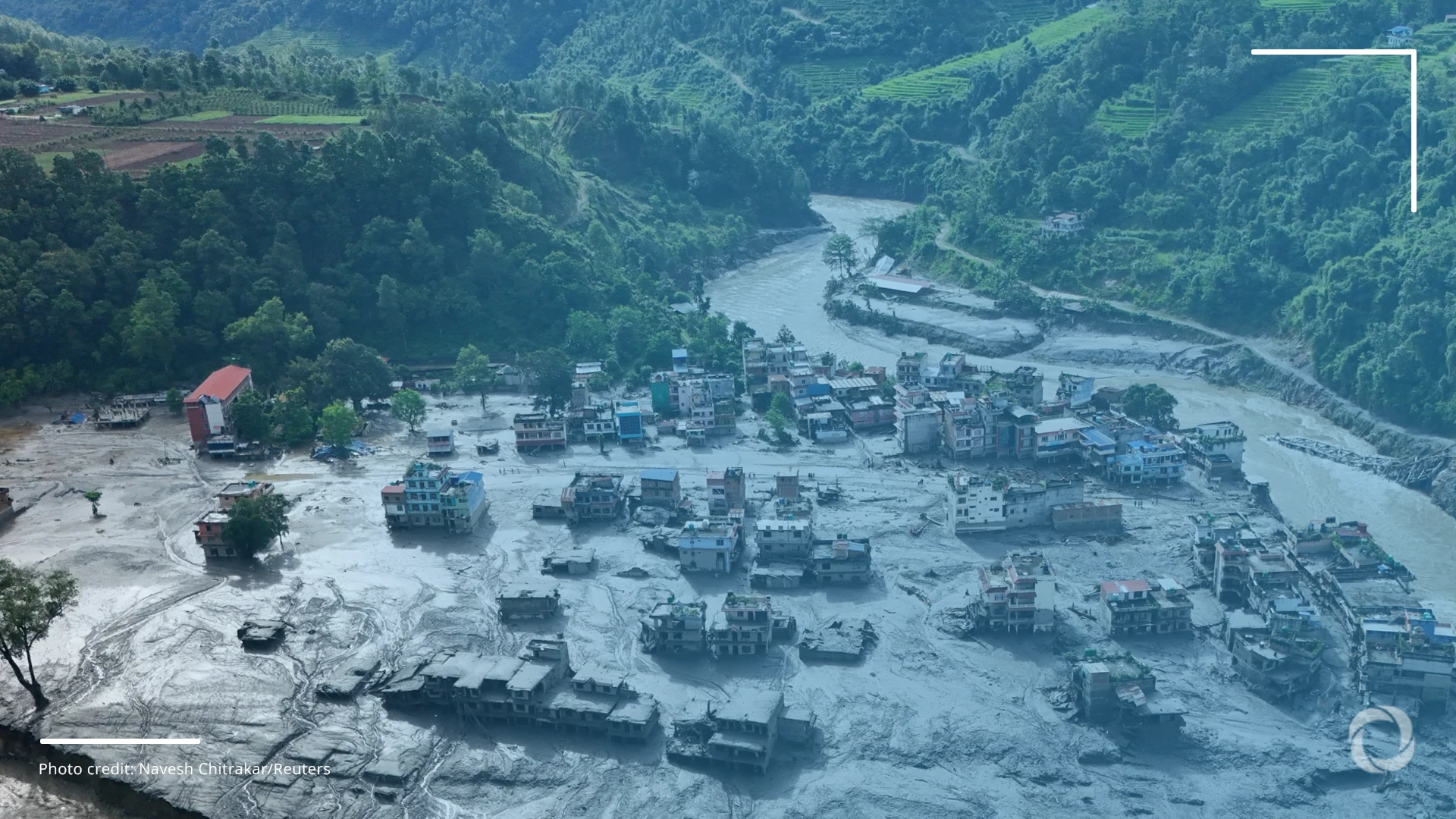
Nepal’s recent devastating disaster highlights the urgent need to rethink how climate-vulnerable mountain countries can be supported, as communities face complex mountain hazards while bearing the consequences of a crisis they have contributed little to.
The disaster has caused about US$2.7 billion in terms of damage to infrastructure and economic losses, while recovery and reconstruction costs are estimated to be US$4.8 billion, according to the government’s latest assessment. More than 33,000 people have been directly affected.
The flash floods involved a complex mountain hazard, triggered by an ice-rock avalanche that rapidly developed downstream to form new lakes and create additional risks. This has prompted the government and international partners to rethink the existing disaster risk models, mainly focusing on monitoring and early-warning systems.
As world leaders gather at the 81st session of the United Nations General Assembly (UNGA) this week, alongside Nepal’s Prime Minister Balendra Shah, Nepal’s experience demonstrates why recognizing the unique vulnerabilities of mountain nations and ensuring predictable climate finance must be central to delivering climate justice.
A test for loss-and-damage finance
On 31 August, Nepal submitted a request for US$20 million to the global financial mechanism, the Loss and Damage Fund, the global financial mechanism established to help vulnerable developing countries to address climate-related damage. The country’s Foreign Minister described the move as a demand for justice. Yet, the amount is just a tiny fraction in view of Nepal’s estimated financing needs. The fund, set up in 2022, has so far received requests totaling US$2.8 billion from around the world, but the board has yet to approve a single payment to any country.
If a disaster can generate billions of dollars in recovery costs while the available grant financing remains comparatively limited, climate justice becomes not only a question of responsibility but also one of whether the existing financial mechanisms are capable of responding at the scale required.
From early warning to early action
As transboundary mountain rivers cross borders meaning that the rapid sharing of upstream observations is vital; Nepal’s disaster monitoring and warning systems must better connect cryosphere, geological, meteorological, and hydrological observations. The UN Decade for Cryospheric Sciences (2025–2034) provides an important framework for this work.
Dr. Dhiraj Pradhananga, UNESCO Chair in Mountain Cryosphere and Water, explained to DevelopmentAid:
“The Decade should help Nepal and the wider Himalaya to move from simply observing a changing cryosphere to turning cryospheric knowledge into actionable risk information, early warning and adaptation, developing stronger open monitoring and data sharing, integrated mountain early-warning systems, and the greater involvement of local communities in preparedness and response.”
The lesson, therefore, is not that Nepal needs more technology and resources. It needs integrated science, quicker information sharing and community-owned early warning systems that can convert scientific information into action, Dr. Pradhananga added.
It is important to note that an early warning does not simply involve providing information or increasing the lead time. During the recent disaster, some communities downstream reportedly did receive warnings, but these did not result in timely evacuations. The lesson, as experts suggest, is that Nepal requires community-centered systems with clear thresholds, trusted communication channels, identified evacuation routes, and regular preparedness drills. A warning system can only reduce losses if the information it generates is connected to decisions made on the ground.
Resilience needs predictable finance
Early warning systems can reduce the impact of disasters, but they cannot eliminate vulnerability to climate change. That requires sustained investment before hazards ever strike.
In conversation with DevelopmentAid, Manjeet Dhakal, Lead Advisor to the Chair of the Least Developed Countries (LDC) Group on Climate Change, warned that:
“Nepal’s Himalayan catastrophe is a stark warning of the new climate reality, where warming is destabilizing glaciers, permafrost and mountain slopes, leaving communities with only minutes to respond”.
While adaptation measures and early warning systems remain essential, nevertheless they cannot eliminate every risk. Predictable and sustained adaptation finance is therefore vital to helping vulnerable communities to prepare for climate impacts, strengthen resilience, and reduce the scale of future losses.
“Deep and immediate emissions cuts must limit further warming, while predictable adaptation finance builds resilience,” Dhakal stressed. “When impacts exceed those limits, rapid, accessible and grant-based loss and damage finance must support recovery, long-term resilience building and human security.”
Rebuilding without reproducing vulnerability
To ensure climate justice for Nepal, post-disaster intervention should go beyond simply rebuilding infrastructure. The key issues to address, as experts highlight, should be climate-resilient infrastructure, disaster risk reduction, sustainable water and energy security, mountain ecosystem protection, early warning systems, and building the resilience of vulnerable mountain communities.
The sustainable development priority is to connect science, water, cryosphere, infrastructure and communities. The recovery should not only focus on rebuilding but on strengthening the knowledge, institutions and community capacity needed to live more safely in a changing mountain environment. So, for Nepal, the central challenge is how to rebuild in a way that reduces future exposure rather than reproducing it.
Talking to DevelopmentAid, Dr. Arun Bhakta Shrestha, a Senior Advisor at the International Centre for Integrated Mountain Development, explained four key interventions for Nepal’s post-disaster period.
Firstly, as climate finance has no actual category for mountain countries as it does for small island states, and Nepal produces only 0.09% of the world’s emissions but pays a heavy price, this gap requires a policy response, not merely sympathy. Secondly, this disaster is now a real test of whether the Loss and Damage Fund can work at all, not just for Nepal. Thirdly, as this mountain sits on the China-Nepal border, disaster planning cannot therefore be undertaken by one country alone. Fourthly, this reconstruction is a real test of the ‘build back better’ approach. How Nepal balances these interventions in the face of tight budgets and time pressure will also be a lesson for other countries, Dr. Shrestha added.
Similarly, Dr. Pradhananga stressed that Nepal requires sustained investment in the ability to observe and understand the changing pattern of the mountain cryosphere and water systems. This is important not only for disaster risk but also for agriculture, hydropower, livelihoods, ecosystems and downstream water security.
The infrastructure test for Nepal
For Nepal to be successful in its mission to build back better, the government must plan for the development of climate- and environment-resilient infrastructure. While Nepal is already working on a climate-resilient hydropower guideline, this so far only covers hydropower production.
Global evidence from the World Bank suggests that the added cost of resilience is usually modest, at around 3% of the total project cost, while every dollar invested can generate about US$4 in avoided future losses. This suggests that resilience should be treated as an investment rather than a reconstruction expense.
As a detailed breakdown for Nepal’s current reconstruction is not available, resilience measures risk competing for the same budget as basic repairs rather than being assessed according to the future losses they could prevent.
The disaster has clearly exposed weaknesses in risk assessment and the siting of hydropower facilities. A total of 13 hydropower projects, with a combined capacity of 759 megawatts, have been damaged or destroyed. About two-thirds of that capacity was still under construction and had not yet earned any revenue.
Dr. Shrestha observes that Nepal has spent years mapping glacial lakes, which is important work, but what recently occurred was a rock-and-ice avalanche from a slope no one had been monitoring. He suggests that going forward, multi-hazard risk assessment should be a requirement before a hydropower project is approved, instead of being treated as an optional choice.
What gets rebuilt first?
The concerns about the distribution of reconstruction resources are genuine, as hydropower plants and the trans-Himalayan Kathmandu-Kerung trade route do matter to the entire economy and are likely to attract significant attention as well as funding.
Small, remote places such as Timure and Syabrubesi face a different risk: national economic priorities could push their needs down the reconstruction agenda. Nepal’s experience after the 2015 earthquake demonstrated the difficulties of reaching remote communities during reconstruction activities.
The recent disaster provides an opportunity for Nepal to rebuild hydropower intakes, bridges and roads using proper hazard maps, prepare and implement climate-resilient hydropower guidelines, and mobilize resources to build a stronger early warning system.
Nepal cannot prevent every mountain hazard, but it can reduce the element of surprise, limit exposure, and strengthen the capacity of communities and institutions to respond. The real test of climate justice, therefore, is not only whether Nepal receives funding after disaster strikes, but whether international finance and national planning will help the country to become safer before the next catastrophic event hits.