
Add us as your preferred source on Google to see more of our content in Search.
 Add to Preferred Sources
Women health workers, no need to politicize COVID-19 and European response to the pandemic. Here is what you missed from last week’s headlines in the international development sector:
Women health workers: Working relentlessly in hospitals and at home
Women globally make up over 70 percent of workers in health, including those working in care institutions. They are on the front line of the fight against COVID-19 and these past few weeks have been the worst they have ever seen. As a result of the pandemic they are facing a double burden: longer shifts at work and additional care work at home.
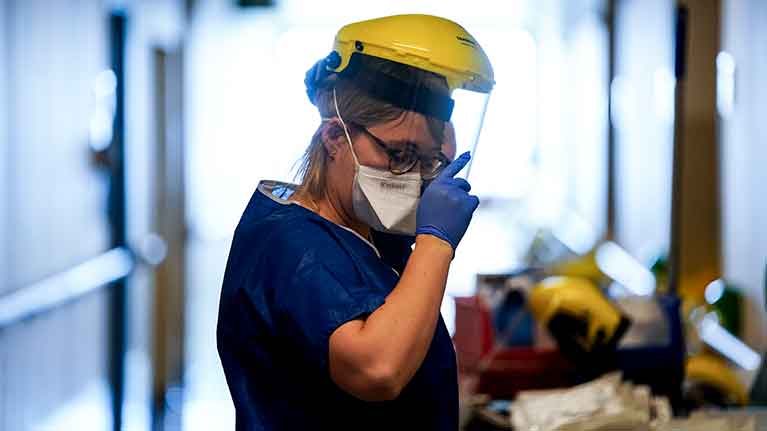
For the almost 100 million female workers in health and care institutions around the world, balancing work and family responsibilities has always been a challenge. The outbreak has shed light on these longstanding gender inequalities. It has also exposed and exacerbated an already existing global care crisis. In normal circumstances, women perform a daily average of 4 hours and 25 minutes of unpaid care work against 1 hour and 23 minutes for men. The pandemic, along with its associated closure of schools, childcare and other care facilities have heavily increased the daily time spent in unpaid care work.
This is particularly true for female health workers living in single-headed households who might have no other option but to care themselves for their children and older parents when returning from work, with the risk of infecting them with COVID-19.
No need to politicize COVID-19
The COVID-19 pandemic should not be politicized as unity is the “only option” to defeat the disease, the head of the World Health Organization (WHO) said.
Responding to criticism levelled at the agency, Tedros Adhanom Ghebreyesus said, emphasizing that “my short message is, please quarantine politicizing COVID.”
“We should work across party lines, across religious lines. We shouldn’t waste time pointing fingers,” said the WHO chief.
Describing the disease as “Public Enemy Number One”, he also underscored the need for global solidarity at this time.
“For now, the focus should be on fighting the virus. There are many unknowns, and we don’t how it will behave in the future”, he said.
Tedros recalled how the United States and the former Soviet Union came together in the Cold War era to work on eradicating smallpox.
EU development ministers discuss common European response to the pandemic
The EU development ministers discussed the EU’s common response to the global impacts of coronavirus. At the meeting, Minister for International Development Ville Skinnari told about Finland’s first-hand measures.
The spread of the coronavirus pandemic may aggravate the world’s humanitarian crises. The situation is worst in fragile countries and countries affected by prolonged conflicts with a poor healthcare system and a great number of people in a vulnerable position. People who are staying in refugee camps and similar settlements are hit hardest. Additional global measures are therefore necessary to strengthen the ability to be prepared and to prevent and contain the virus.
EU development ministers are exploring a coordinated and strong European response to the impacts of coronavirus in developing countries. The EU focuses on those in the greatest distress and on countries with a poor socio-economic capacity to cope with crises.
DevelopmentAid Editorials
DFI Files: Norfund – Norway’s Investment Fund with a strategic focus on clean energy projects
Norway is the tenth largest donor country in the Organisation for Economic Co-operation and Development (OECD) and 2019 saw its largest ODA budget to date – US$4.6 billion. Norfund is one of Norway’s instruments for channeling its development assistance to developing countries, representing a share of a little more than 10% of total development aid. Its global investment portfolio currently stands at approximately. US$2.6 billion and 163 projects and, by the end of 2019, almost half of its portfolio had been invested in clean energy projects.
Associate Writer | How NGOs’ leaders can fight Coronavirus
We all have a role to play in preventing the spread of the Coronavirus (COVID-19). The advice from health experts has been clear: social distancing, washing our hands with soap for 20 seconds, and minimizing how often we touch our faces. They’re great preventive methods, and the evidence base for their effectiveness is rapidly growing as we learn more about how the virus is transmitted.
Here’s what else has happened
EIB Group: The European Investment Bank Group, the bank of the European Union, announced details of a comprehensive response to the coronavirus pandemic outside the EU that will provide up to € 5.2 billion in the coming months.
EBRD and EU: The EBRD, together with the European Union (EU), is stepping up efforts to support small and medium-sized enterprises managed and owned by businesswomen in Morocco, in the face of the coronavirus pandemic.
Japan: The Government of Japan has contributed USD six million in support of the International Organization for Migration’s COVID-19 response. The donation will be used to provide emergency assistance to the Islamic Republic of Iran and surrounding developing countries to prevent the further spread of the novel coronavirus.
CEB: The Council of Europe Development Bank (CEB) has issued a €1 billion seven-year maturity COVID-19 Response Social Inclusion Bond. The funding will be used to support CEB member countries in mitigating the social and economic impact of the ongoing COVID-19 crisis.
Reports
In times of crisis, solidarity between workers and employers is paramount, says the ILO
Collective efforts and solidarity between Employers’ and Workers’ Organizations is critical to respond effectively to the impact of the COVID-19 pandemic in the world of work, according to a new International Labour Organization (ILO) report.
COVID-19 has in many parts of the world jeopardized the health and safety of millions of people and put immense pressure on businesses, jobs, and livelihoods. In crisis settings, collaboration and dialogue between employers and business membership organizations (EBMOs) and workers’ organizations can boost economic and social progress and enable accelerated recovery.
Read and download the report.
Women hit harder by socio-economic impacts of COVID-19 in Asia-Pacific, says UN Women report
Gender and social inequalities that underpinned societies in Asia and the Pacific before the novel coronavirus disease 2019 (COVID-19) pandemic are now exacerbated, making bad situations for women and girls even worse, warns a new report by UN Women.
The report entitled The First 100 Days of the COVID-19 Outbreak in Asia and the Pacific: A Gender Lens, presents a snapshot of the gender dimensions of the socio-economic impacts of the pandemic and captures promising practices for integrating gender in preparedness and response planning while proposing potential and entry points to mitigate the socio-economic impacts for women and girls in the region.
Read and download the report: The First 100 Days of the COVID-19 Outbreak in Asia and the Pacific: A Gender Lens.
Events
International Forum on Enhancing a Sustainable Nuclear Supply Chain
Helsinki, Finland
7-10 September 2020
This year’s Forum has a special focus on the management of the supply chain. The Forum also involves promoting the application of IAEA safety principles and standards, other IAEA guidance and informing participants about other international rules, regulations and standards and related literature.