

Add us as your preferred source on Google to see more of our content in Search.
 Add to Preferred Sources
The Development Bank of Austria (OeEB), founded in 2008, is the youngest member of the European Development Finance Institutions (EDFIs). In the last decade it has grown to be the sixth largest EDFI in terms of portfolio. OeEB positions itself as a thematically focused development bank with a broad geographic approach and, in the next two years, aims to conclude 80% of its new businesses in its three main thematic focus areas.
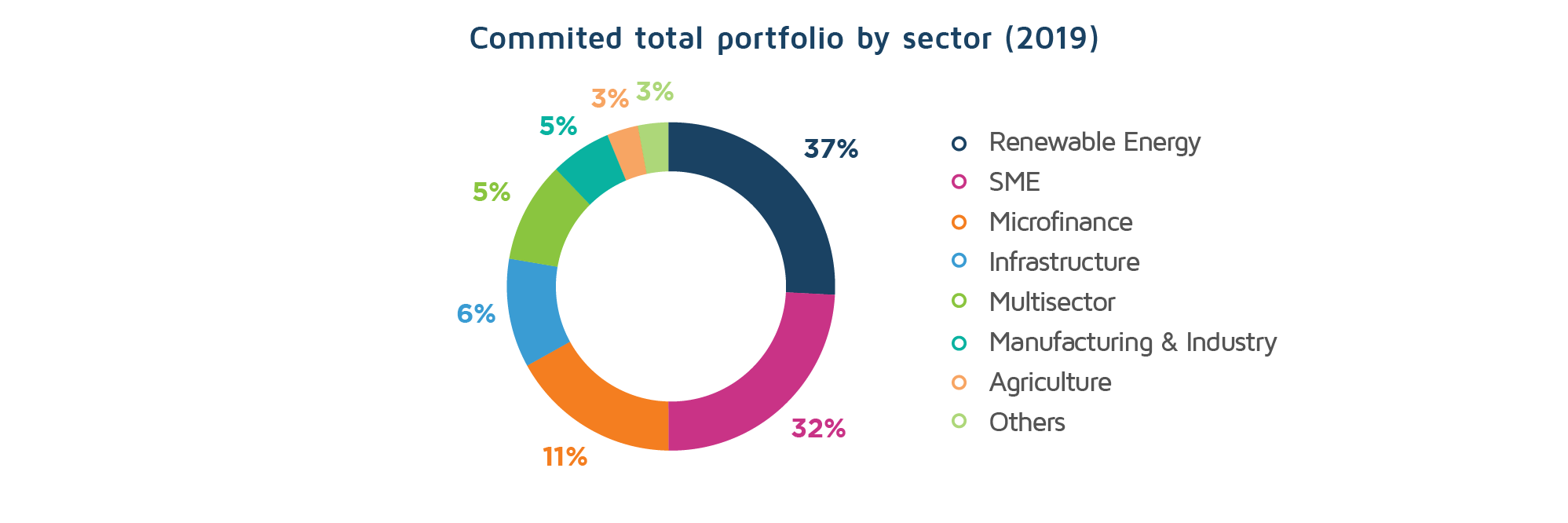
OeEB is a wholly-owned subsidiary of the Austrian export credit agency, Oesterreichische Kontrollbank (OeKB). With the mission of promoting sustainable development, OeEB invests in profitable private sector projects in developing and emerging countries. It does so by using the three instruments it has available: investment finance (specifically loan facilities), equity capital and business advisory services. At the end of 2019, in just eleven years, the bank had managed to build up a portfolio with a value of approx. EUR 1.37 billion, 91% percent of which was put into investment financing loans with the remainder being invested in equity projects.
The Austrian DFI positions itself as a thematically focused development bank with a broad geographic reach. As outlined in their strategy for 2019-2023, the bank focuses on three main thematic areas – renewable energy, small and medium-sized enterprises (MSME)/financial inclusion and infrastructure. Within the scope of these focus areas, OeEB pursues two cross-sector issues – climate protection and gender equality. According to their current five-year strategy, the bank aims to conclude 80% of its new business projects over this period in the three above mentioned areas.
Source: https://www.oe-eb.at
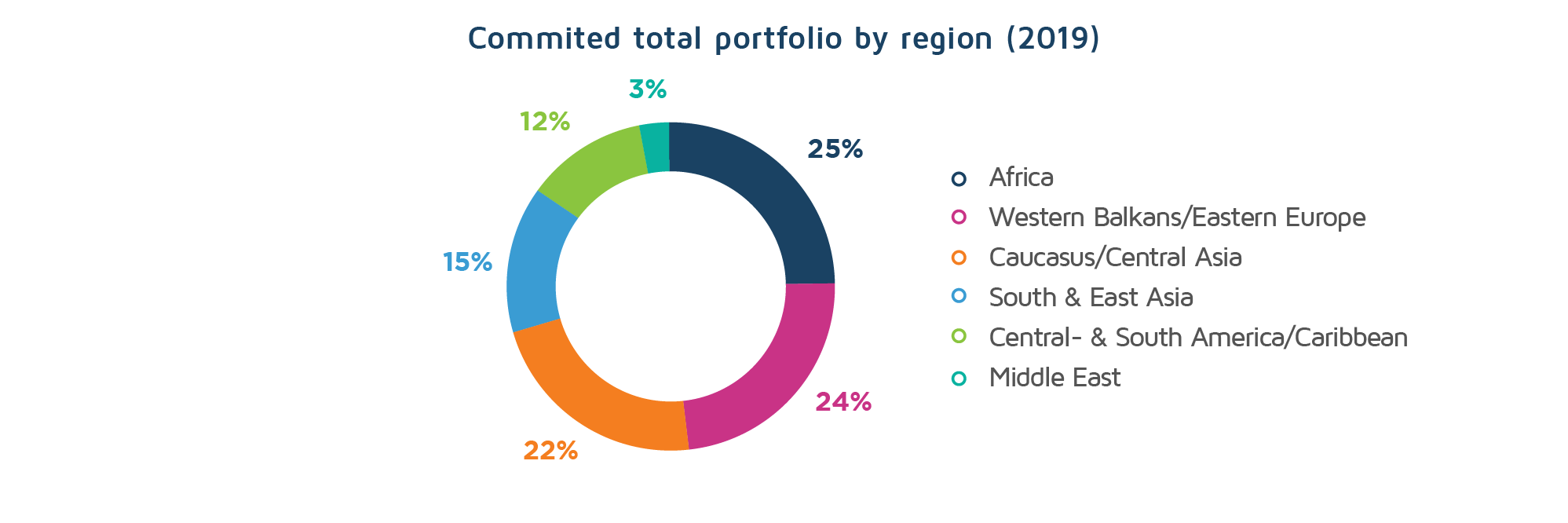
OeEB has not indicated a fixed list of target countries or regions for its current strategy. Instead, the bank has a broad geographic reach, thus providing services to all the developing countries on the OECD DAC list. As OeEB states, this wide-ranging geographical approach offers them a great deal of flexibility in responding to any changes that might arise in certain regions and countries and avoids any possible bottlenecks with regard to private sector access to financing. However, the bank strives to achieve a balanced geographical spread of its commitments in order to avoid any accumulation of risk in a particular region.
Source: https://www.oe-eb.at
OeEB envisages itself financing opportunities in the least developed countries (LDC) and specifically in Africa. By 2023, it hopes to conclude an average of 25% of its new business in the LDCs and an average of 20% of its total new business projects in Africa. Currently, the bank’s portfolio stands at 15% of investments being made in Africa and although the institution has a special focus on Sub-Saharan Africa, it does plan to expand its operations to the Maghreb countries and northern Africa in general.
In 2019, the African-Austrian SME Investment Facility (AAIF) was established, a new facility hoping to provide EUR 10 million of financing by the end of 2021. Initiated by the Ministry of Finance of Austria and managed by OeEB, AAIF aims to support SMEs from Austria and the European Union in setting up businesses or developing projects in Africa.
This article is part of DevelopmentAid’s series, DFI Files. You can read our previous analysis of European DFI activity Denmark’s IFU and its climate-related portfolio and Germany’s DEG.