
Add us as your preferred source on Google to see more of our content in Search.
 Add to Preferred Sources
The last decades have seen an evolving client-base for multilateral development banks (MDBs), given some instances of strong economic growth in several developing countries. The number of developing countries classified as being low-income has halved in the last 15 years – from 63 in 2000 to 31 in 2015. This has also reduced the number of countries eligible for concessional loans from MDBs. This article will look at the lending mechanisms of the largest MDBs and which are the top borrowing countries from MDBs.
What financial instruments do MDBs provide?
Multilateral development banks are international financial institutions providing financial assistance to developing countries. The mandates of MDBs are to foster economic and social development and to support regional and economic integration.
The most common financial instrument provided by MDBs is in the form of loans with most providing two types of loan facility – on concessional terms and on non-concessional terms. Non-concessional assistance offers market-based loans that are provided mostly to middle-income countries, some low-income countries and private sector firms in developing countries. Concessional financial assistance offers loans on below market-based terms to governments of low-income countries. MDBs also provide equity and guarantees and, less often, lines of credit which are the least common financial instrument.
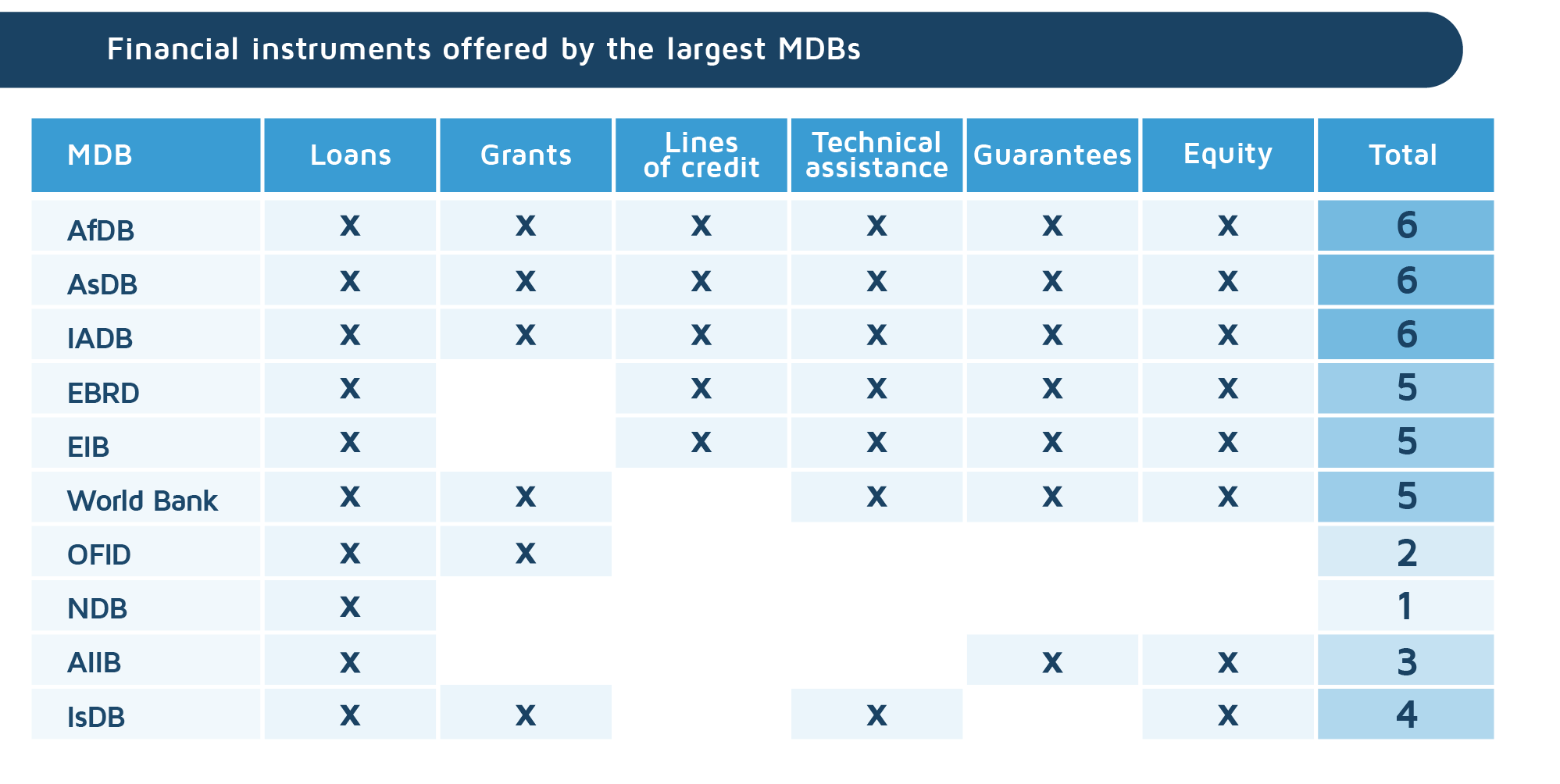
Source: Overseas Development Institute, A guide to multilateral banks, 2018
The largest development banks normally provide concessional loans and the number of borrowing countries that can access these opportunities varies from bank to bank. For the Inter-American Development Bank (IADB), Haiti is the only country eligible to borrow on concessional terms, while all the other countries working with the IADB are only eligible to borrow on non-concessional terms. In the case of the African Development Bank, more than half of the borrowing countries are eligible for concessional lending. The World Bank and the Asian Development Bank stand somewhere in between the two positions, with more balanced lending in terms of concessional and non-concessional loans.
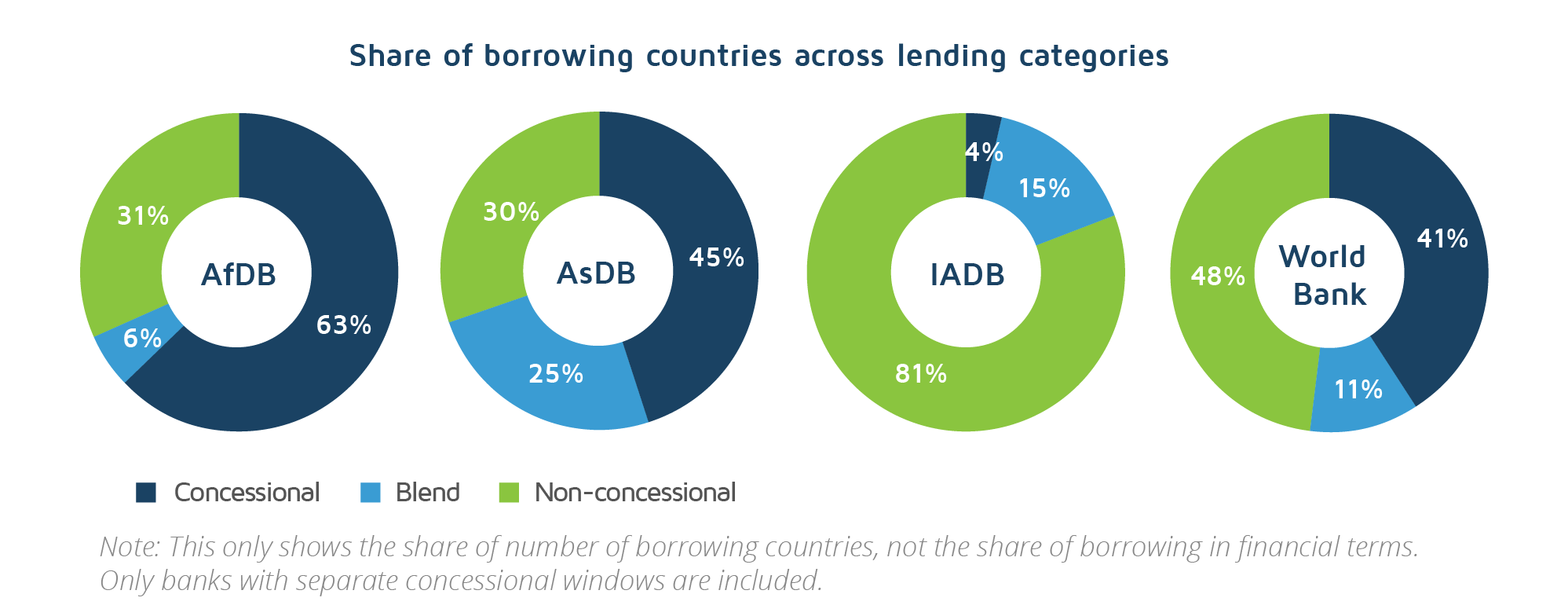
Source: Overseas Development Institute, A guide to multilateral banks, 2018
Multilateral Development Banks presence at country level
The number of MDBs from which a country can borrow varies from case to case, depending on the development level of the country with the number of banks decreasing as the country becomes richer. On average, borrowing countries receive assistance from six MDBs while low-income countries are served by an average of 7 banks and upper-middle-income countries by 5 banks. Countries such as Azerbaijan, Egypt, and Tajikistan receive assistance from ten MDBs while Croatia, Cuba, and North Korea from only two.
MDB coverage differs substantially by region and sub-region. The regions where the largest numbers of MDBs operate are central Asia (including the Caucasus) and North, West, and East Africa. The Pacific stands out as having the least number of banks with only the AsDB, EIB, IFAD, and the World Bank operating in that region.
The number of borrowing countries varies from bank to bank reaching a maximum of 203 countries in the case of the European Investment Bank. The large global MDBs provide financing to over 100 countries all over the world with the number of countries borrowing from the World Bank totaling 144. The large regional banks provide finance to up to 54 countries located in specific regions.
Top borrowing countries from the largest MDBs
According to the available data, Turkey is one of the top countries borrowing from MDBs being among the main borrowers from four of the largest international and regional development banks while China is one of the top borrowers from the Asian Development Bank, the International Bank for Reconstruction and Development and the International Fund for Agricultural Development. The countries borrowing from the Inter-American Development Bank are all located in Latin America which is where the bank’s focus of development lies.
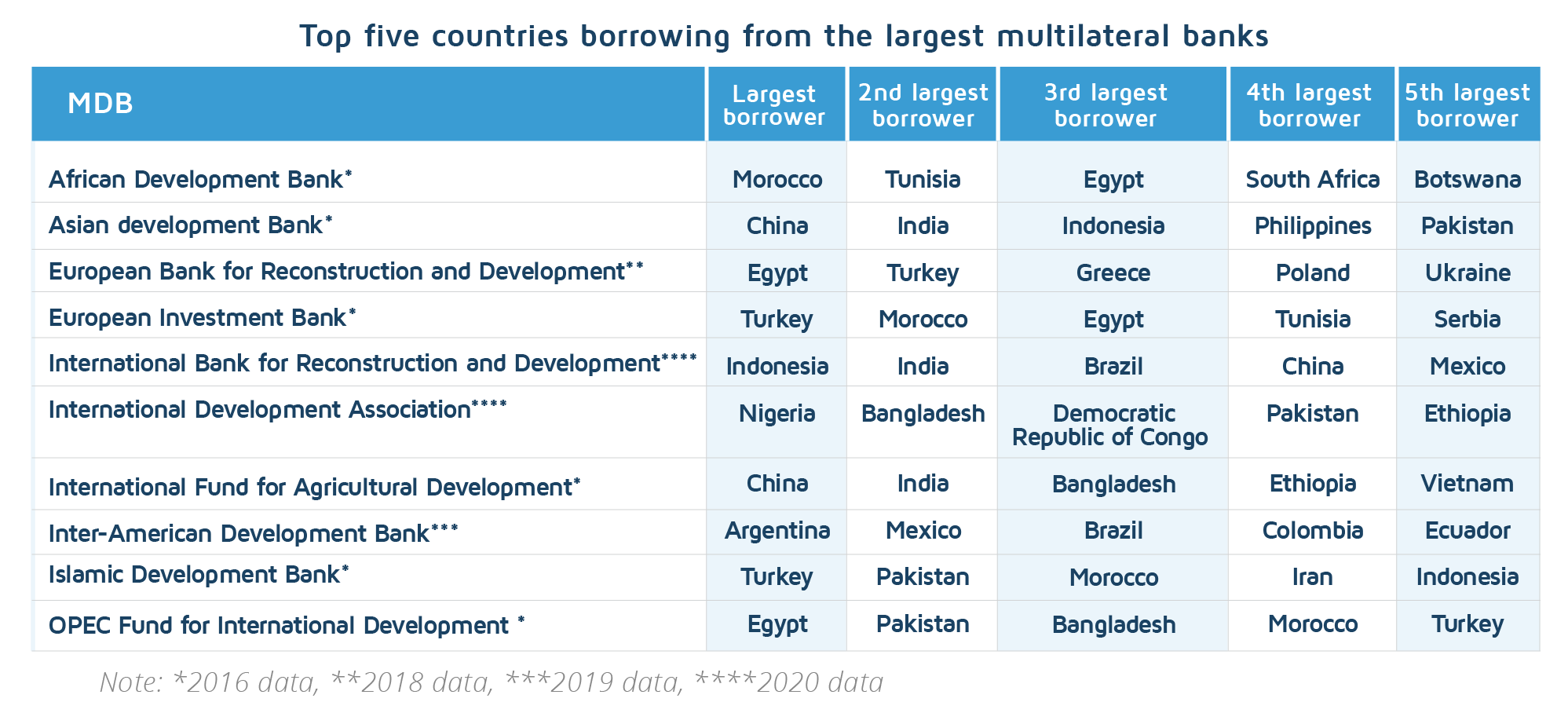
Source: Overseas Development Institute, A guide to multilateral banks, 2018
DevelopmentAid is a leading platform in the development business, gathering together information on tenders, grants, jobs, experts, organizations, donors, and references. To learn more about funding opportunities from the Asian Development Bank, the African Development Bank, the Asian Infrastructure Investment Bank, or the European Bank for Reconstruction and Development, register on the DevelopmentAid platform and become a member.