
Add us as your preferred source on Google to see more of our content in Search.
 Add to Preferred Sources
The last decade has been marked by significant progress in various fields such as science, medicine, and technology, but at the same time, the number of issues in the world today has steadily grown. In 2020 and 2021, undoubtedly some of the most uncertain and difficult years of the last decade, the biggest problems in the world were the COVID-19 pandemic and poverty. However, the years that followed continued to be somewhat complex and certainly anything but problem-free.
Over the last decade, humanity has lived through a series of negative and dangerous events, with some of the most uncertain and difficult years probably being 2020, 2021, and 2022 with the coronavirus (COVID-19) pandemic, rising poverty, wars breaking out in various regions of the world, and migration issues have all been set against a backdrop of the widening gap between the rich and the poor.
The war in Ukraine, the Israel-Hamas conflict, and worsening humanitarian crises in many other countries, combined with energy shocks and high inflation, caused numerous economic shocks and periods of stagnation across the continents.
So, what are the most pressing issues in the world today?
As a platform to address global issues that cannot be resolved by any single country, the United Nations organization is spearheading humanity’s struggle to survive. Its most visible efforts concern resolving conflicts and undertaking peacekeeping activities. Below is a list of the world’s greatest, according to the UN.
 Global poverty crisis
Although according to the World Bank, the total number of people living in extreme poverty (living on less than US$3 per day) declined from 2.3 billion in 1990 to 831 million in 2025, the reduction in poverty is now slowing down.
For the most part, this impressive decline was the result of strong economic development in countries in East Asia and South Asia.
But the pace of global poverty reduction has gradually slowed down, driven by a combination of interconnected crises, including weaker economic performance, conflicts, and extreme weather conditions affecting various regions.
Low-income nations are affected the most, and if the trend continues at its current pace, eradicating extreme poverty will take decades.
Extreme poverty in sub-Saharan Africa
In particular, people living in countries in sub-Saharan Africa experience extreme poverty due to conflicts and fragility, according to the report by the World Bank.
However, economic development alone cannot resolve this issue because the region requires substantial investment in infrastructure, although various institutions can help people to improve their position in society in terms of income, education, and overall quality of life.
590 million people could be living in extreme poverty by 2030 if current trends remain, according to the United Nations Statistics Division.
Experts have estimated that just 3 (or fewer) out of 10 nations will be able to reduce their national poverty by half by the end of the decade unless there is a significant acceleration in the process.
Possible solutions to poverty:
- End marginalization by ensuring equality and representation for all
- Provide preventative education and treatment assistance during an epidemic
- Offer recovery interventions during climate disasters
- Help refugees and internally displaced people in terms of health, nutrition, and shelter
- Improve education
- Increase the level of food security and clean water access
- Put an end to conflicts
See also: Absolute poverty vs relative poverty, what is the difference?
Conflicts and inequality are among the major causes of extreme poverty with inequality seriously affecting many people, especially children. This brings us to the next global issue.
 Children’s poor access to healthcare, education and safety
Every child must benefit from the right to proper healthcare, access to education, and grow in safety, and every society benefits from increasing children’s life prospects. Despite this, millions of children worldwide face serious challenges linked with their birthplace, gender, or circumstances.
Over 72 million children around the world who are old enough to attend elementary school are not enrolled. Marginalization and poverty are two major social issues.
Possible solutions to protect children’s rights:
- Encourage education for both children and adults in less developed countries
- Provide clean water
- Ensure basic healthcare
- Tackle gender inequality
- Improve childhood nutrition
How many kids are facing poverty today?
Around 900 million children today face multidimensional poverty, which means they lack proper education, healthcare, access to safe water, nutritious food, and shelter.
At the same time, around 412 million children are suffering from extreme poverty, and these are not only children in sub-Saharan Africa but also in high-income nations too, reports UNICEF.
What does extreme poverty among children lead to?
Poverty-stricken children have low living standards and acquire fewer skills for their future employment so as a result they have very little chance of earning sufficient money as adults.
If a child grows up lacking the ability to engage in physical and cognitive development, the chances of having good social opportunities when they grow up decrease.
Children from the poorest households have twice the mortality rate of those with higher socioeconomic status.
Children of war
According to the Peace Research Institute Oslo (PRIO), in 2024, countries that were affected by conflict were home to around 1.6 billion children. Of these, 520 million were living in areas located within 50 km of the conflict events.
Africa remains the continent where most children live in conflict zones, with their number reaching 218 million. Needless to say, children and adults in these regions face numerous issues, one of which is hunger – the next major global issue in our list.
 Access to food and the fight against hunger
By 2030, it is less likely that the world will achieve Sustainable Development Goal 2: Zero Hunger, according to international agencies and media. The situation in countries that have faced food insecurity and where populations suffer from hunger has worsened further as a result of the health and socioeconomic effects of the COVID-19 pandemic.
The global population today exceeds 8 billion people, and there is enough food to feed them all. Based on the most recent State of Food Security and Nutrition in the World (SOFI) report, 733 million people experienced hunger in 2023.
Between 2022 and 2023, hunger worsened in the Caribbean, Western Asia, and the majority of African sub-regions.
If we fail to end extreme poverty, experts anticipate that 582 million people will suffer from chronic undernutrition by 2030, half of whom will be in Africa, according to the World Health Organization.
The same organization has also stated that roughly 2.33 billion people worldwide experienced moderate to severe food insecurity in 2023, with this figure having failed to improve since 2020.
According to the World Food Program, around 9 million people die each year from hunger-related factors – most of them being children aged 5 or younger.
Possible solutions:
- In regions impacted by conflict, humanitarian, development, and peacebuilding initiatives should be rolled out quickly
- The resilience of those who are more prone to economic hardship should be increased
- To reduce the cost of nutritious foods, governments should intervene at various points in the food supply chain
- Deal with poverty by focusing on interventions that help those suffering
- Food environments should be reinforced. In addition, it is important to influence consumer behavior to encourage eating habits that are good for both people and the environment.
- Experts believe that the immediate solution to the food crisis linked to the conflict in Ukraine could be monetary, mainly because of the rising food prices. If governments and donors are able to help people to pay for food, fewer will go hungry.
 Migration
Massive migration movements impact all UN Member States, necessitating greater collaboration and responsibility-sharing.
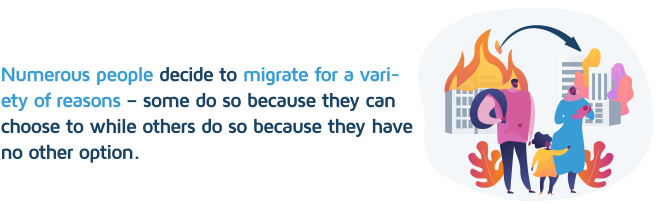
The United Nations Member States endorsed the New York Declaration for Refugees and Migrants (A/RES/71/1), wherein they acknowledged that there is a need for a comprehensive strategy for migration. The New York Declaration recognizes the beneficial contributions of migrants to inclusive and sustainable development and pledges to defend their dignity, human rights, and basic freedoms, irrespective of their migration status.
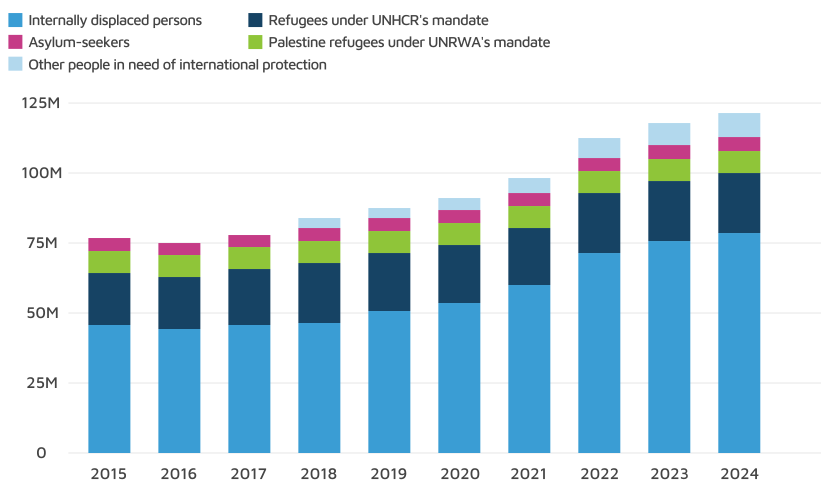
Based on 2025 data from UNHCR – the UN Refugee Agency, 117.3 million people around the globe were forced to flee their homes due to persecution, wars, violence, and other issues.
UNHCR also indicates that even though displacements have increased by nearly 100% over the last 10 years, there was a slower growth in the second half of 2024.
The graph below illustrates the number of forcibly displaced people around the globe in the period between 2015 and 2024.
Source: UNHCR
 Climate сhange
There is no economy or individual that is unaffected by climate change. By 2050, this problem could force 216 million people to relocate within their own nations. The changes in weather may worsen water stress and reduce crop output, particularly in the most food-insecure areas of the world.
One of the major problems on our planet is linked to global temperatures that are continually rising. By 2100, studies show that there is a 50% likelihood of facing global warming that is higher than 3.5 degrees Celsius and a 10% probability of witnessing warming higher than 4.7 degrees Celsius relative to temperatures registered between 1850 and 1900. This would result in more severe shifts in weather patterns, food and resource shortages, and the more rapid spread of diseases.
At COP28 in Dubai, held at the end of 2023, the World Bank unveiled ambitious plans to boost climate funding, improve initiatives for carbon markets, and much more.
In 2024, at COP29 held in Baku in Azerbaijan, where almost 200 nations gathered, the attendees agreed a new funding goal aiming to assisting nations to deal with climate disasters as well as to embrace the many advantages of the clean energy revolution. A historic deal was struck to increase funding for poor nations from $100 billion per year to $300 billion per year by 2035.
Experts believe that from 2030 to 2050, the consequences of climate change, such as malnutrition, malaria, diarrhea, and heat stress, will lead to 250,000 more fatalities a year. By 2030, the costs of direct health harm are projected to be between US$2 and US$4 billion annually.
Needless to say, without sufficient support to plan and react, those regions with inadequate health infrastructure, mostly in poor nations, will be least prepared to handle this situation.
Possible solutions:
A reduction in greenhouse gas emissions and increased awareness of the necessity to turn green are among the solutions that can make a significant difference. In addition, strategies to cut carbon emissions and opting for replanting are among the effective ways to address climate change.
Biodiversity collapse and ecosystem degradation
Biodiversity today suffers from extreme weather events, including floods and droughts, which are triggered by climate change.
Brief statistics of what is happening and the consequences we may see:
- The annual cost of biodiversity loss to the world economy is US$10 trillion, indicates the World Health Organization. This includes healthcare costs from the spread of diseases and agricultural losses due to a decrease in pollinators.
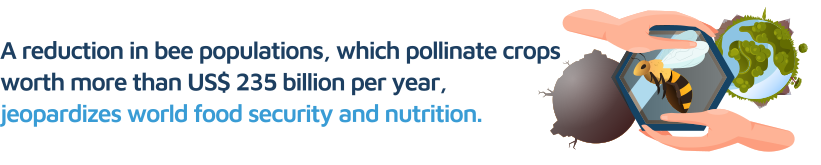
- Pollinators are essential to almost 75% of the world’s food crops, which account for US$235-577 billion of the world’s agricultural outputs each year.
- About 1 million species may become extinct due to biodiversity loss.
- More than half of modern medications come from natural sources.
Forests and wetlands are the ecosystems that play the role of carbon sinks, “inhaling” carbon dioxide and controlling temperatures on Earth. Moreover, forests are home to 80% of terrestrial biodiversity.
Wetlands are essential for water filtration, and healthy ecosystems supply 75% of the world’s freshwater resources. Yet, 35% of wetlands have disappeared since 1970.
If these systems were to be destroyed, humanity could be exposed to floods, heatwaves, and a myriad of other dangers related to climate, all of which together will subsequently lead to malnutrition and the spread of malaria and other vector-borne diseases.
Possible solutions:
- Focus on protected areas and conservation zones by, for example, expanding national parks, marine reserves, and wildlife corridors so that various species have safe habitats.
- Restore the habitat through reforestation, wetland rehabilitation, and coral reef restoration, for instance.
- Tackle pollution and overconsumption by addressing hazardous emissions, plastic waste, agricultural runoff, and pesticide use.
- Promote sustainable land and ocean use by regulating overfishing, illegal logging, and land conversion.
- Tackle the invasive species that destroy native ecosystems.
 Wars and military conflicts
Maintaining peace and security is crucial to preventing poverty and high numbers of refugees and asylum seekers. With an increasing number of territories becoming conflict zones, the number of poor and displaced women and children is on rise, causing the spread of diseases and a halt to economic progress.
Preventive diplomacy and demilitarization are the two key tactics for avoiding conflicts. Preventive diplomacy is defined as those actions undertaken to avoid conflicts from forming or worsening. It can also help to limit the spread of existing hostilities. Mediation, conciliation, or negotiation are all options to tackle this world issue.
Sadly, wars and conflicts are at the top of the list of the greatest world issues. 2022 and 2023 were marked by a number of conflicts that led to many casualties and displaced people. The conflicts in many countries, including Ukraine, Palestine, Sudan, Lebanon, and the Democratic Republic of the Congo (DRC) have led to catastrophic events and threatened a massive number of people who have been forced to flee their countries in search of shelter.
Individuals with disabilities and the elderly are the most vulnerable because they may not be able to escape high-risk regions.
Conflict in Ukraine
According to the UN Refugee Agency data (as of February 2025):
- Ukraine has 3.7 million internally displaced people
- Global data shows that there are 5.9 million refugees
- Around 10.8 million people required humanitarian aid.
Conflict in Gaza
Data from the United Nations Relief and Works Agency for Palestine Refugees in the Near East (UNRWA) shows that:
- More than 1.9 million Palestinians (over 90% of the population) throughout the Gaza Strip have endured displacement with many facing multiple displacements (at least 10 times).
- Since the ceasefire began, numerous people have attempted to return.
- The Ministry of Public Works and Housing (MoPWH) has stated that 92% of homes have either been completely destroyed or are seriously damaged.
Conflict in Sudan
The data from the United Nations shows that:
- Over 12 million people have been forced to leave their homes since the conflict began in April 2023 with their lives being threatened.
-
- 3 million have settled in neighboring countries (Chad, South Sudan and Egypt).
- 8.4 million have been internally displaced.
-
- More than half of the population is currently experiencing severe hunger as a result of the conflict’s catastrophic effects on food security.
Conflict in Lebanon
The United Nations agencies reported that:
- Around 900,000 individuals have been displaced within Lebanon.
- Around 557,000 people have crossed into Syria, predominantly Syrians who had previously sought refuge in Lebanon.
- From October 8 2023,to September 18, 2024, 50,210 housing units were destroyed or damaged.
- Since 23 September 2024, over 200,000 people have faced displacement
Conflict in the Democratic Republic of the Congo (DRC)
Decades of fighting between the Congolese military and non-state armed groups have resulted in severe violations of human rights, particularly gender-based violence.
The UN Refugee Agency reports that:
- There are 6.4 million internally displaced persons and more than 1 million refugees in nearby nations.
- In the first half of 2024, over 940,000 people were displaced due to escalating conflict in eastern regions.
- A 2024 mpox outbreak has been identified in the country, with possible cases among displaced communities.
Latest refugee data from the UNHCR:
Globally, 117.3 million people were forcibly displaced as of mid-2025 due to persecution, hostilities, violence, abuses of human rights, or incidents that gravely disrupt public order.
Of those millions of people:
- Internally displaced – 73.5 million as of the end of 2024
- Refugees – 36.4 million
- Asylum-seekers – 8.4 million
- Other categories that require international assistance – 6.1 million
It is significant that 34% of all refugees found shelter in five nations:
- Islamic Republic of Iran – 2.5 million
- Turkey – 2.7 million
- Colombia – 2.8 million
- Germany – 2.7 million
- Uganda – 1.9 million
67% of refugees come from just five nations:
- Venezuela – 6.5 million
- Syrian Arab Republic – 5.5 million
- Ukraine – 5.3 million
- Afghanistan – 4.8 million
- Sudan – 2.5 million
Did you know that from 2018 to 2024, annually, around 337,800 children were born into this world as refugees?
Furthermore, children (those below the age of 18) accounted for 40% (49 million) of the 123.2 million forcibly displaced people (registered in 2024; the data for 2025 shows 117.3 million).
 Water contamination crisis
One of the most pressing issues in the world today is the lack of access to safe tap water. There is no life without water – apparently a simple truth, but one that people seem to overlook. Poor management and irrational use forces communities to migrate in search of drinking water. Industries are polluting underground water, and this issue is growing massively.
- Research published in “Science” estimates that 4.4 billion people (over half of the global population) drink contaminated water.
- More than 2 billion people do not have access to clean drinking water in their homes, according to the Centers for Disease Control and Prevention.
- 1.5 billion people lack access to basic sanitary facilities.
- 2 billion people lack access to basic sanitation services.
- Agriculture is responsible for 70% of global water loss.
- Annually, 297,000 children under the age of five die from diarrheal infections caused by poor sanitation, hygiene, or contaminated drinking water.
- 80% of wastewater is discharged into the environment without being processed or reused.
Experts warn that the spread of illnesses such as cholera and typhoid fever is largely caused by poor water quality, lack of sanitation, and poor hygiene.
Possible solutions to the water pollution issue:
The most efficient technique to reduce water pollution is to treat water (filtration, disinfection, etc.) before it reaches the waterway system. Clearing wastewater of pollutants can be performed via biological, physical, and chemical operations.
 Human rights violation
Human rights are universal, regardless of race, gender, ethnicity, religion, or any other status, but what if this only happens on paper?
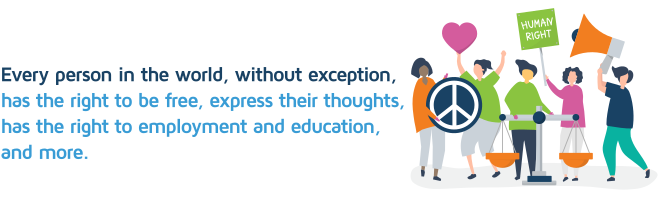
Indeed, the problems in today’s society are linked with the constant violation of human rights – gender inequality, human trafficking, the lack of freedom of speech – all of these can be witnessed in the 21st century in every country, even in developed nations.
Gender equality
50% of the world’s population are women and girls. Gender equality is not only a crucial human right; it is also necessary for a peaceful society, the full development of human potential, and long-term evolution.
Possible solutions to gender inequality:
- Speak up for what you believe in
- Pay attention to what others have to say
- Defend yourself from discrimination
- Raise public awareness of a problem
- Get the media to talk about it
- Demonstrate to those in positions of power that they are being watched
 Global health issues
There is no comprehensive list of the top global health challenges because this field is dynamic and ever-evolving. In addition, new threats and hazards related to global health are constantly emerging as seen by the monkeypox outbreak that occurred in 2023. On the other hand, certain global health problems are long-term and may be on the list forever, including cancer, air pollution, and tuberculosis.
Major health problems in the world include:
- Communicable diseases
Influenza outbreaks and COVID-19 are examples of pandemics that highlight our susceptibility to widespread infections, many of which begin in animals. Anxiety and fear are common reactions to pandemics. Other worrisome infectious diseases worth attention are HIV/AIDS, malaria, and Ebola, which have remained deadly for decades.
- Environmental factors
Air pollution and climate change have a serious impact on our health. Hurricanes, floods and droughts make disease transmission easier among large populations of people.
- Inequalities and poor healthcare access
Poor access to healthcare, increased infant mortality rates, mainly in low-income nations, and income inequality around the world make it virtually impossible for many families to afford healthcare.
- Political aspects
People become increasingly exposed to diseases as wars within or between countries damage essential infrastructure. As a result, they look for ways to escape the harmful situations that jeopardize their safety but diseases can spread swiftly when people migrate.
- Noncommunicable diseases (NDCs)
Cancer, heart disease, and diabetes are just a few examples of noncommunicable diseases (NCDs). The risk factors for NCDs include the use of tobacco products and alcohol, obesity, a poor or unbalanced diet, and lack of exercise. Although these global health concerns are present everywhere and are responsible for almost 3 out of every 4 deaths worldwide, low- and middle-income nations make up 77% of NCD deaths.
Possible solutions to global health issues:
- Empower marginalized populations
- Encourage physicians to work in rural regions
- Implement policies that eliminate obstacles and improve access to healthcare
- Promote health breakthroughs (improve research, increase funding)
- Education can help people recognize and improve lifestyle variables such as poor diets, obesity, cigarette use, and alcohol intake, which can lead to NCDs.
- Veterinary medicine can enhance global health since diseases originating from livestock play an important role in the spreading of diseases.
Mental health
Worsening mental health is among the most serious issues in the world today, and this is not because of its sheer scale, but mainly because of the cascading consequences it brings.
One untreated person suffering from mental health issues can affect their family, workplace, and community at the same time. And if we take the issue globally, such ripple effects accumulate into a huge, interconnected crisis that affects the whole of society:
- According to the WHO, over one billion people are currently struggling with mental health disorders.
- Anxiety and depression are among the major causes of long-term disability around the globe.
- Among people aged 15 to 29, suicide caused by depression is one of the main causes of mortality.
Approximately US$1 trillion is lost in productivity annually due to depression and anxiety.
There are only 13 mental health professionals per 100,000 people worldwide, with acute shortages in lower-income countries.
Fewer than 10% of those afflicted in low-income nations receive any care at all, and average government spending on mental health continues to be stagnant at just 2% of overall health budgets since 2017.
Today, more than 80% of nations offer mental health and psychosocial assistance as part of emergency response, whereas in 2020, this figure stood at 39%.
Possible solutions:
- Proper funding is necessary, including increasing health budgets.
- Make mental health part of routine healthcare visits.
- Train more workers in the field. Workforce expansion is crucial, especially in low-income countries.
- Focus on community-based, individual-centered care.
- Focus more on telehealth and online therapy to reach underserved people and those located in remote regions.
- Introduce mental health programs in schools.
- Maker access to mental healthcare available for everyone.
- Share knowledge and resources across countries.
 Weapons accessibility
Multilateral disarmament and armaments restriction are the aims that have been important to the United Nations’ attempts to keep international peace since its inception.
The United Nations has placed a high priority on decreasing and ultimately eliminating nuclear weapons, abolishing chemical weapons, and reinforcing the ban on biological weapons, all of which pose the greatest dangers to humanity.
- A number of multilateral treaties and procedures have been developed as a result of worldwide efforts to regulate, limit, or eliminate specific weapons, including:
- Treaty on the Non-Proliferation of Nuclear Weapons – one of its goals is to stop nuclear weapons and weapons technology from spreading
- Comprehensive Nuclear-Test-Ban Treaty – its goal is to prohibit nuclear weapons trial explosions, as well as any other nuclear explosions
- Biological and Chemical Weapons Convention – forbids biological and toxin weapon manufacturing, procurement, transmission, storage, and use
- Arms Trade Treaty – controls the international conventional armaments trade.
Is Artificial Intelligence a global issue?
The pace of AI development is quicker than society is able to adapt to, and AI safety regulations cannot keep up with the technology’s growth.
Despite its obvious advantages, AI can nevertheless be considered to be a major global issue for a number of reasons, including those linked to ethics (for example, deepfakes), the environment (huge power usage), and, not least, cybersecurity.
When discussing AI being used for cyberattacks and virus creation, its potential has now increased dramatically, and those dangers have become a reality, explains Yoshua Bengio, Scientific Director at the Mila Quebec AI Institute.
AI can widen the gap between poor and developed countries
There is a need for a robust policy to resolve this issue. For many years, poorer countries have slowly been catching up with more developed nations in terms of healthcare, education, and income, but AI could reverse that progress.
This is because richer countries (and big tech companies) have the capital, infrastructure, and talent to develop and use AI, whereas poorer nations do not.
AI impacts women and young people
Women and young people are particularly vulnerable. Many women tend to work in jobs that AI can replace, such as data entry, customer service, administrative work, and clerical roles, according to UNDP.
Young people, particularly those at the start of their career, aged 22 to 25, are finding it more difficult to obtain entry-level jobs because AI is already able to do the tasks required for particular roles. It therefore becomes harder to gain experience and climb the career ladder if there are no longer any first rungs on that ladder.
AI-powered disinformation
According to UN data, over 70% of the UN peacekeepers surveyed mentioned that misinformation has had a serious impact on their ability to carry out their work.
AI is utilized to produce and disseminate offensive material, such as photographs of child sexual assault and nonconsensual explicit material, with a focus on women and girls. In addition, the UN is extremely concerned that generative AI can amplify racist, xenophobic, Islamophobic, and anti-Semitic content.
Possible solutions:
- Global regulatory frameworks are required since, currently, each country has its own AI regulations, while many countries have no policies at all.
- International coordination, such as the EU AI Act model, must be deployed on a global scale.
- Bridge the digital divide via the three main pillars established by the ILO: 1. Improve digital infrastructure, 2. Promote technology transfer, 3. Build AI skills in developing nations.
- More focus should be placed on public awareness and political will. Most people fail to fully understand the risks of AI since this topic is seldom discussed. With this in mind, authorities must ensure people are informed about the risks involved with AI (public awareness) and people must demand action from their governments (political will). Only then will governments consider focussing on robust laws and regulations around the use of AI.
FAQ: Global issues explained in four answers
Q: What is the world’s #1 problem in 2026?
A: Climate change remains the most universal threat, since it exacerbates almost every other global crisis, including hunger, poverty, displacement, and disease.
Q: What are the top 10 world problems in 2026?
A: The most pressing issues today are climate change and the threat to biodiversity, armed conflicts, water contamination, global health crises (access to healthcare), worsening mental health, poverty and hunger, migration, human rights violations, and the growing risks of AI.
Q: Can the biggest world problems actually be solved?
A: The short answer is yes, but only through coordinated international action, sustained funding, political will, and by addressing the root causes.
Q: How can we solve the world’s biggest problems?
A: To solve these issues, we need a combination of policy reform, proper investments in education and healthcare, a reduction in greenhouse gas emissions, ending and preventing conflicts through diplomacy, and assisting marginalized communities worldwide.
Final word
Although the top 10 global issues certainly help to establish what governments and ordinary people around the world should focus on, there are many other problems that everyone should be aware of, including the aging of the population, AIDS, and law and justice. Tackling at least some of these is possible but requires a lot of effort, patience, and understanding.