
Add us as your preferred source on Google to see more of our content in Search.
 Add to Preferred Sources
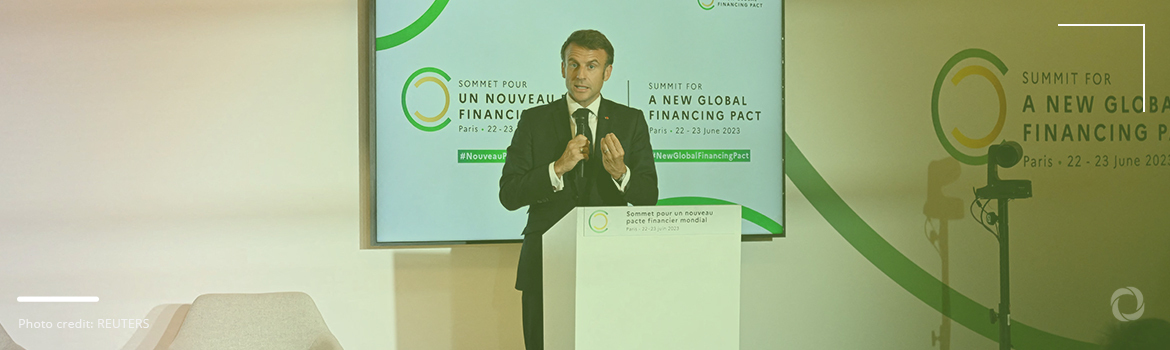
Paris became the center of attention during the top-level summit for a New Global Financial Pact which took place from June 22 to 23, 2023. The event served as a critical platform for deliberating the far-reaching implications of multiple crises, including climate change, energy shortages, health emergencies, and economic instability, with a special focus on the most vulnerable nations. Central to the summit’s agenda was the pivotal question of how to secure essential financial resources to effectively tackle these urgent issues. This significant gathering was driven by the vision articulated by President Emmanuel Macron during the COP27 in Egypt.
The summit brought together over 100 heads of state and government, more than 300 international organizations and civil society representatives, along with 70 private sector partners and philanthropists.
Throughout the summit, the participants made a series of commitments to update the international financing system which has remained largely unchanged for almost 80 years since the establishment of the Bretton Woods money management system. The goal was to better safeguard and restore our planet while ensuring affordable financing for the most disadvantaged populations.
The move was warmly welcomed particularly now that public debt has hit record levels in every country and one-third of developing countries and two-thirds of low-income countries are facing the risk of debt distress.
Addressing participants at the summit, French President Emmanuel Macron said:
“The fight against poverty, the decarbonization of our economy in order to achieve carbon neutrality by 2050, and the protection of biodiversity, are closely intertwined. We, therefore, need to agree together on the best means to address these challenges in the poor and emerging countries of the developing world when it comes to the amount of investment to comprehensive reform of infrastructure like the World Bank, the IMF, and public and private funds, and how to set a new process in motion.”
The summit’s participants directed their attention to ways of alleviating the burden of debt. The proposed approaches included renegotiating or restructuring debts, as well as redirecting financing away from debt repayment and towards investments in resilience, immediate crisis response, and safeguarding global public goods. In this context, there was a shared agreement that ongoing efforts should be devoted to debt restructuring for countries like Ghana and Zambia so as to provide them with the necessary support and assistance.
Among others, Côte d’Ivoire and France reached an agreement aimed at reducing debt and promoting development. Under this contract, 1.14 billion euros of Ivorian bilateral debt will be converted into grants to fund various development projects, with 72.1 million euros due to be allocated to education initiatives.
In a similar vein, the United Kingdom, France, the United States, Spain, Barbados, the World Bank Group, and the Inter-American Development Bank jointly launched an appeal to bilateral, multilateral, and private-sector creditors to incorporate climate-resilient debt clauses into their lending practices by the end of 2025. Some entities have committed to being early adopters of these clauses, making them available by COP28. This initiative aims to provide borrowing nations with greater fiscal flexibility to effectively respond to unforeseen challenges and shocks, ultimately fostering resilience and sustainable development.
During the summit, the participants stressed the need for comprehensive changes across key economic sectors to achieve net-zero emissions and a biodiversity-positive world. They recognized that steady economic growth, a strong human capital base, and shifts in production and consumption patterns are crucial components of this transition. Notably, France and the UK have taken the lead in developing a global roadmap for bio credits, which includes biodiversity-positive carbon credits and biodiversity certificates. The aim is to encourage increased private sector investment in natural capital by leveraging expertise and defining time-bound actions for upcoming climate and biodiversity conferences. Furthermore, a Just Energy Transition-Partnership was established between Senegal and G7 countries which aims to support Senegal to achieve 40% renewable energy in its energy mix by 2030.