

Add us as your preferred source on Google to see more of our content in Search.
 Add to Preferred Sources
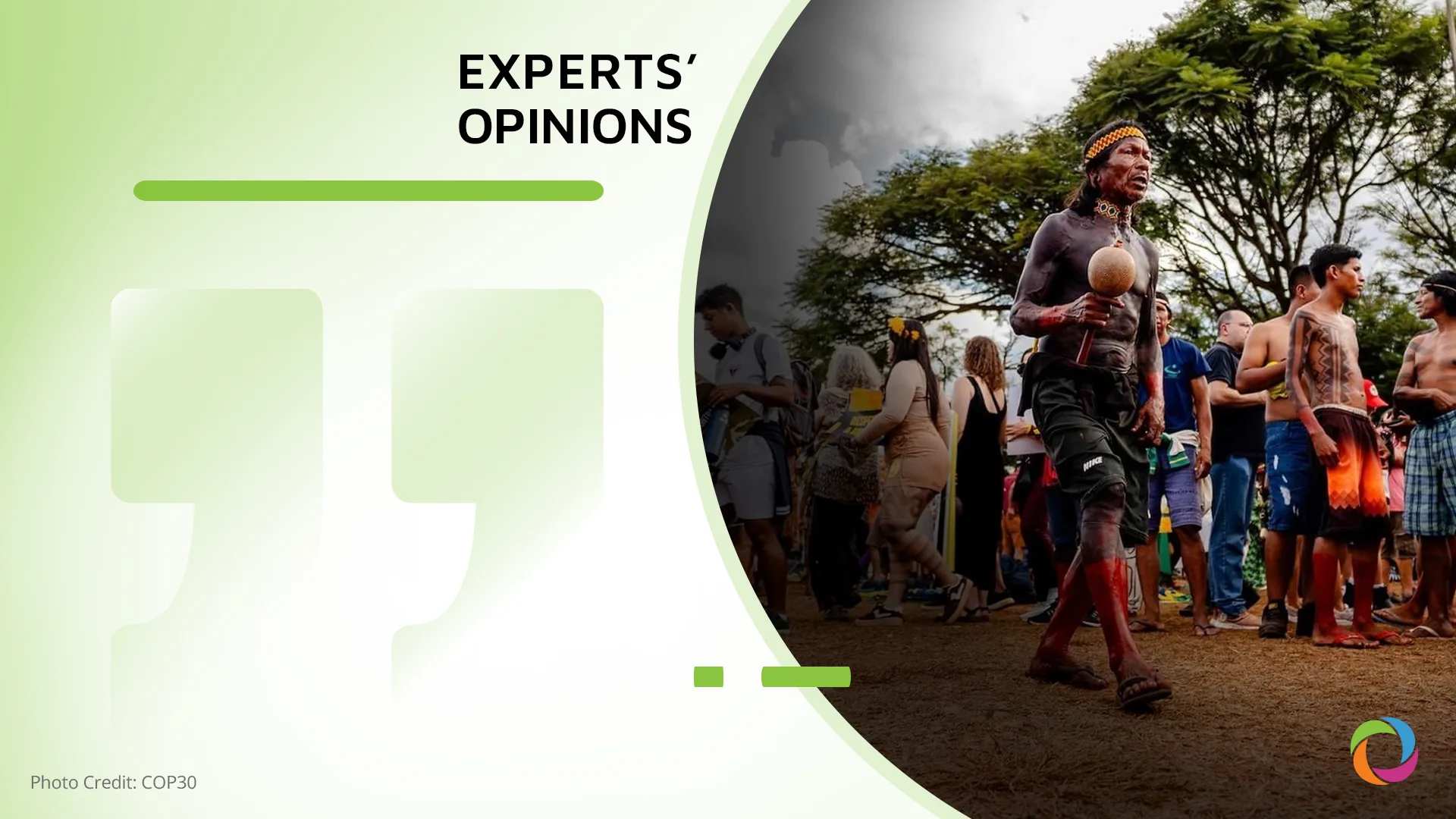
The 2025 United Nations Climate Change Conference, also known as COP30, was marked by protests and debates. The event that took place in Belem in Brazil became a vital turning point for indigenous communities, marking their largest participation with over 3,000 representatives and highlighting a long-standing tension within global climate negotiations. Although indigenous people are among the most affected by climate change, their participation in the decision-making processes remains limited. This paradox raises important questions about equity, representation, and the future of climate justice. We asked several experts to share their perspective on COP30. Check out their opinions below.
Key Takeaways:
- The UN Climate Change Conference COP30, held in November 2025 in Belém, was characterized by the historic participation of indigenous peoples and strong protests over the future of the Amazon forest.
- During COP30, Amazonian indigenous groups forced their way into the Blue Zone — exposing a deep contradiction at the heart of global climate diplomacy.
- According to experts, the involvement of local and indigenous communities in global climate change platforms remains minimal in most countries, heightening the risk that their concerns and needs will be ignored.
- Climate negotiations can be recalibrated by promoting partnerships between indigenous communities, governments, and international organizations through direct climate financing.
DevelopmentAid: Does the global fight against climate change overshadow the rising challenges faced by indigenous communities worldwide?

“Yes, it does because there is a clear disjunction between the cadre of professionals and politicians who are engaged in climate change negotiations and the local communities that have to confront the tangible risks and impacts of climate change. Global negotiations often prioritize technocratic solutions, such as large-scale decarbonization and mitigation interventions at the expense of indigenous voices. Moreover, many negotiators have limited direct involvement in implementing mitigation measures at the local level, increasing the likelihood of overlooking issues that directly affect indigenous communities. For some negotiators, participation in these forums/spaces becomes a repeat exercise, continuing from where the last conference ended without adequately taking stock of contextual changes or evolving realities within local communities since their previous engagement. In addition, the involvement of local and indigenous communities on global climate change platforms remains minimal in most countries, heightening the risk that their concerns and needs are ignored. The transmission of outcomes from global climate change discourses rarely reaches grassroots levels. Even when such information does filter down, it is seldom translated or interpreted into common/local languages, limiting its accessibility and application, and thereby missing opportunities to strengthen local resilience. Ideally, indigenous communities should be meaningfully involved through ground-level systematic stocktaking of the existing interventions and the formulation of positions that genuinely reflect their priorities and lived experiences.”

“Events at COP30 were a reminder that indigenous people stand at the frontline of climate and biodiversity loss, and at the heart of the solutions we urgently need. The global narrative on climate action is broadening, and many now recognize that the disruptions felt most intensely by indigenous communities are deeply connected to the wider planetary crisis. In addition, across regions, indigenous rights to land, resources, and self-determination are still systematically treated as secondary to short-term economic interests and corporate profit, particularly in sectors linked to extraction, infrastructure, and industrial agriculture. These communities face accelerating pressures – from deforestation and ecosystem collapse to threats to cultural identity and food security – yet their food systems, governance traditions, and ecological knowledge hold insights that global policy processes have not fully integrated. What often gets overlooked is the complexity of their stewardship practices, which offer tangible pathways for resilience and regeneration. Elevating indigenous perspectives strengthens climate action because it connects global ambition with a grounded, place-based understanding. When their realities are acknowledged, and their expertise is taken seriously, climate responses become more accurate, more just, and more durable.”

“Despite the world committing to fight global warming, indigenous people seem to be among the missing voices. They have a long history of living in balance with their environment and applying the best conservation practices. Around the globe, climate change is affecting the right of indigenous people to access food and essential resources and retain their nomadic lifestyle. Despite the fact that globally they are still face certain challenges that need to be addressed and remedied, if they are consulted, their knowledge system around the world could be vital to address climate change. Some of their fundamental rights are still to be fulfilled such as the rights to participation, survival, development and protection. The commitment to address global warming should be in tandem with the key factors that ensure indigenous rights. An initiative that can link indigenous people with local, national and international consultation bodies will ensure that there is a place in the policy for global reflection and also their knowledge that addresses the threats facing the ecosystem that indigenous people depend on.”

“The 30th United Nations Climate Change Conference (COP30) in 2025 witnessed the largest indigenous people’s participation worldwide (3,000 indigenous participants), with more than 40,000 attendees from over 50 countries, representing more than 1,300 social movements, civil society organizations, and collectives from around the world. Although indigenous people gained many benefits from COP30, they still have not yet been formally invited to participate in the negotiations of the United Nations Framework Convention on Climate Change in order that the challenges they face could be considered in official decision-making.”

“The events at COP30, where indigenous groups from the Amazon entered the restricted Blue Zone, show a continuing problem as to how global climate issues are being handled. Although climate change affects everyone, it has a much bigger impact on indigenous communities. They face loss of land, cultural damage, displacement, and environmental harm. However, their voices are not given enough attention in the talks that will decide the future of their lands. Often, the global effort to fight climate change has ignored the serious, local challenges these groups face. They are seen as people who have an interest in the issue, not as people with rights and as leaders of knowledge.”

“Recent scenes from COP30 — where Amazonian Indigenous groups forced their way into the Blue Zone — exposed a deep contradiction at the heart of global climate diplomacy. Indigenous people face the hardest consequences of climate change, yet remain on the margins of the negotiations that will determine their future. Their exclusion is not accidental; it reflects a model of climate action that prioritizes carbon markets, national targets, and geopolitics over lived reality in forests, river basins, and ancestral territories.”

“The global fight against climate change grows stronger each year, yet it often eclipses the urgent struggles of indigenous communities — the very guardians of Earth’s most fragile ecosystems. As nations push for carbon markets, mega renewable-energy projects, and ambitious net-zero targets, indigenous people face land encroachment, cultural erosion, and climate decisions made without their consent. Rising seas swallow Pacific homelands, permafrost melts beneath Arctic settlements, droughts threaten pastoral societies, and wildfires endanger entire cultures. In Pakistan, the Kalash community of Chitral stands at the front line where glacial melt, flash floods, and shifting snowfall patterns are damaging their valleys and sacred sites, even as their centuries-old watershed and forest stewardship practices remain overlooked in national climate planning. Yet communities like the Kalash hold profound climate solutions, regenerative farming techniques, biodiversity protection, and water-wise practices that have been passed through generations.”

“Whereas the global fight against climate change is viewed through a national and global perspective, indigenous communities worldwide continue to face the myriad challenges of climate change, including food and nutrition insecurity, ecosystem degradation and compromised living standards. Resource allocation and distribution, both spatial and temporal, are seldom channeled to indigenous communities whose economy is hand-to-mouth. The implementation of climate change mitigation and adaptation strategies remains miles away from where indigenous people have lived all along in the same conditions of inequality and marginalization. The inclusion of indigenous communities in the implementation matrix of the fight against climate change as per the theory of change will ensure the effectiveness of the mitigation of and adaptation to climate change.”
“The global fight against climate change often overshadows the growing challenges faced by indigenous communities. While international negotiations focus on large-scale policies and targets, the lived realities of the communities most affected by deforestation, biodiversity loss, and climate disruptions are frequently marginalized. As a result, climate strategies risk ignoring indigenous rights, knowledge systems, and survival needs.”
Listen to: Who really benefits from COP summits? Paulo C. De Miranda on power, money and climate reality.
DevelopmentAid: How can climate negotiations ensure indigenous communities have a meaningful, sustained influence in global decision-making?
“Climate negotiations can be recalibrated by first promoting partnerships between indigenous communities, governments, and international organizations through direct climate financing. This process should be reinforced by establishing progressive mechanisms to gather climate concerns at the local level, particularly from indigenous communities and other interest groups prior to and subsequently contributing to international conferences/discourses. Such arrangements at national and subnational levels would ensure that negotiators advance the felt needs of the affected communities rather than relying solely on technocratic solutions. Secondly, emphasis should be placed on promoting smaller-scale, locally driven mitigation interventions that contribute to the national and global objectives of sustainable environmental management while simultaneously enhancing community resilience to the risks and impacts of climate change. Another critical avenue is to expand participation by enabling indigenous and local communities to engage on global platforms through accessible virtual mechanisms, delivered in languages that are understood at the local level. Finally, the transmission of outcomes from global negotiations must be streamlined, with clear communication channels that translate complex results into simple, culturally relevant language that can be readily assimilated and acted upon by local communities.”
“Recalibrating climate negotiations starts with a simple but often resisted shift – recognizing indigenous knowledge systems as the core components of effective climate and food system governance, not supplementary inputs. Indigenous communities manage vast carbon-rich ecosystems and biodiversity hotspots, yet their participation in global forums seldom matches the responsibility they carry on the ground. Addressing this imbalance requires negotiations to be anchored in lived realities, including the protection of territorial rights, stronger mechanisms for direct and continuous representation, and predictable access to finance for indigenous-led climate and food system initiatives. It also demands decision-making structures that integrate traditional knowledge alongside scientific evidence from the outset, rather than as an afterthought. When indigenous leaders participate with real influence, with the support and resources required to engage fully, policy outcomes will align more closely with ecological realities. This leads to climate processes that are more coherent, more responsive, and ultimately more capable of delivering genuine climate justice.”
“In order to ensure that indigenous people have a meaningful, sustained influence in global decisions, several actions should be taken at different levels and dimensions. The global community should ensure that at the local, national, and international levels, institutions that are led by indigenous people are part of global reflection during negotiations. Consultation should be undertaken with various indigenous people to ensure that their contribution is taken into consideration at the global level and in consideration of their knowledge on the sustainable management of natural resources. Knowing that climate change resources are less available to indigenous people, effort should be made to allocate yearly resources that help the institutional development then contribute to data collection prior to consultation at the national, regional and international levels. Finally, the global community’s policymakers should ensure the full participation of indigenous people from different ecosystems in global decision-making. Negotiators should also engage in restrictive policies that guide consultation during the decision-making process. This should be achieved through the clear identification of the role and responsibilities of indigenous organizations across the globe. By doing so, the global community will then guarantee one of the fundamental rights which is participation.”
“There can be no real climate fighting without considering the challenges of indigenous peoples who have coexisted within their environment in harmony for longer periods. They have guaranteed to the world that there is no climate future without them. They will remain vigilant and continue to fight, appoint their indigenous leaders as climate authorities and promote the indigenous movement as one of the supporting forces for global climate governance. I think through the direct and continuous pressure on negotiators, countries and the UN, they will influence decision-making, be directly involved in future negotiations and achieve climate justice.”
“To address this, indigenous communities need to be fully part of the decision-making process, not just included as token participation. This means having official representation, the right to speak, and funding that helps their climate projects. Including traditional knowledge in policies, while making sure indigenous peoples give their consent before any action is taken, can change the direction of the global climate effort towards fairness and justice.”
“The fight against climate change should not eclipse the escalating threats that indigenous communities face – land grabbing, criminalization, displacement, and cultural erosion. True climate justice demands shifting from tokenistic consultation to shared authority. That means guaranteed seats at negotiation tables, the right to free, prior and informed consent, decision-making powers in climate funds, and full recognition of indigenous ecological knowledge as a science, not symbolism. If the world wants lasting climate solutions, indigenous communities must move from protest outside the walls to leadership within them. Their voices are not “stakeholder input” — they are indispensable to the planet’s survival.”
“To correct the imbalance, climate action must place indigenous rights at its core. This requires securing land rights, enforcing Free, Prior and Informed Consent (FPIC), directing climate finance to community-led initiatives, integrating indigenous knowledge into adaptation plans, and ensuring meaningful representation in climate forums. A just, resilient future depends on transforming indigenous people from neglected victims into indispensable partners in healing the planet.”
“To ensure indigenous people have meaningful and sustained influence, climate negotiations must move beyond symbolic participation. Indigenous representatives should be formally included in decision-making processes, supported with adequate resources, and recognized as knowledge holders rather than merely stakeholders. Creating spaces where indigenous experiences and traditional knowledge can directly inform climate policy is essential for equitable and effective solutions. The meaningful participation of indigenous people in global climate negotiations strengthens climate justice, enhances policy relevance, and ensures that responses to climate change reflect the needs and voices of those most directly affected.”
Listen to: Rebecca Thissen: Putting Climate Justice at the Heart of COP30
Environment and climate is one of the sectors with the largest job board openings in the international development sector. On the DevelopmentAid platform, experts can find hundreds of jobs related to this sector. However, only Individual Professional Members can access their details in just a few clicks, saving time and resources. In addition, they can check for tenders and grants for individuals, organization contacts, and much more valuable information to help them to land excellent opportunities.