
Rockefeller Foundation and Global Energy Alliance commit more than US$100 million to expand electricity access in Africa
Add us as your preferred source on Google to see more of our content in Search.
 Add to Preferred Sources
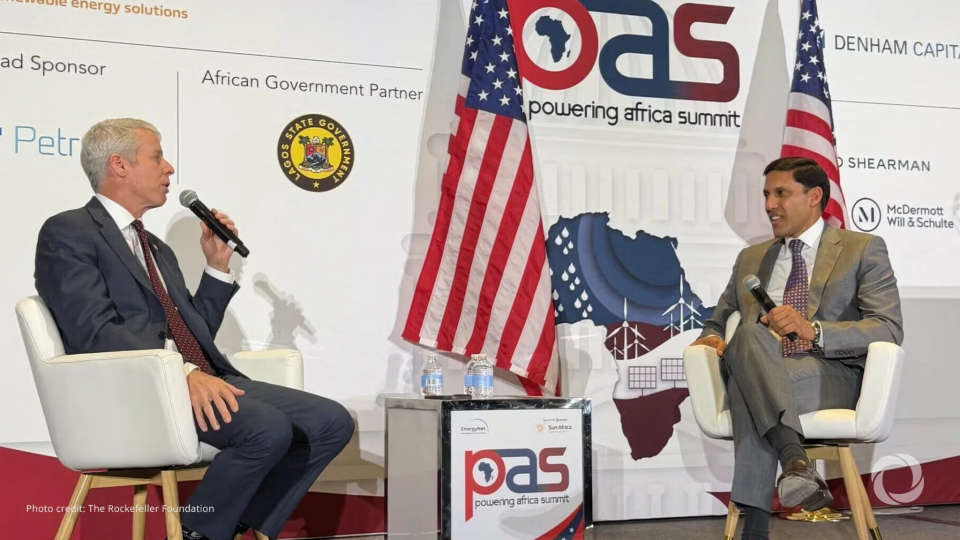
At the Powering Africa Summit in Washington, D.C., on March 19, 2026, The Rockefeller Foundation and the Global Energy Alliance for People and Planet announced they have committed more than US$100 million to support Mission 300, according to a press release by The Rockefeller Foundation. Mission 300 is the World Bank Group and the African Development Bank‘s effort to connect 300 million people in Africa to electricity by 2030. The joint commitment has grown more than tenfold since the two organizations first pledged US$10 million in September 2024. Dr. Rajiv J. Shah, President of The Rockefeller Foundation, made the announcement during a fireside chat with Chris Wright, Secretary of the U.S. Department of Energy. Clean cooking support for communities in sub-Saharan Africa — a key priority of Mission 300 — was also discussed at the event.
Currently, 730 million people still lack access to basic electricity, and an estimated 85% of those live in sub-Saharan Africa. This shortage hinders healthcare, education, digital inclusion, women and children empowerment, and the creation of local jobs. According to the Oxford Poverty and Human Development Initiative, lack of access to electricity is the single greatest predictor of extreme poverty. Mission 300 — a partnership between The World Bank and the African Development Bank, with support from The Rockefeller Foundation, Global Energy Alliance, and Sustainable Energy for All — translates commitments into implementation through national energy compacts, economy-wide reforms, investment programs, technical assistance, and private-sector mobilization. Since its launch in April 2024, around 44 million people across Africa have been connected to electricity, with a pipeline of tens of millions more by the end of 2026.
The US$100 million commitment covers Mission 300 efforts in 23 countries: Benin, Burkina Faso, Democratic Republic of Congo, Chad, Côte d’Ivoire, Ethiopia, Kenya, Lesotho, Liberia, Madagascar, Malawi, Mauritania, Mozambique, Niger, Nigeria, Republic of Congo, Rwanda, Senegal, Sierra Leone, Somalia, Togo, Uganda, and Zambia. Approximately 47% comes from The Rockefeller Foundation and the Mission 300 Accelerator — an initiative of RF Catalytic Capital — and 53% from the Alliance. Key activities funded include technical assistance to more than a dozen National Energy Compact Delivery and Monitoring Units (CDMUs), 18 Mission 300 Fellowships, the Clean Cooking Accelerator Initiative, and investment in Zafiri, Mission 300’s permanent capital fund originated by the World Bank and African Development Bank. The commitment also supports the Global Energy Alliance and CLASP’s Productive Use Financing Facility (PUFF) and a new, more flexible, short- to medium-term technical assistance facility designed to deploy philanthropic capital swiftly.
Dr. Kevin Kariuki, Vice President for Power, Energy, Climate, and Green Growth at the African Development Bank, underlined the importance of catalytic funding.
“Mission 300 is fundamentally about delivery, and turning ambition into results at scale,” he said. “Catalytic capital from partners such as The Rockefeller Foundation and the Global Energy Alliance plays a critical role in strengthening government delivery capacity, de-risking investments, and accelerating projects that can mobilize much larger flows of public and private finance.”
Woochong Um, CEO of the Global Energy Alliance for People and Planet, added:
“Reliable, affordable, abundant electricity is essential for jobs, prosperity, and resilience.”
He noted that the Alliance’s focus is on ensuring new electricity connections translate into durable economic opportunity for people and communities across Africa.
Mission 300 has supported the launch of National Energy Compacts in 30 countries to date to define targets, reforms, and investment priorities. The Alliance’s Global Leadership Council — a coalition of nearly three dozen global finance, clean energy, and philanthropy leaders — is co-chaired by Jonas Gahr Støre, Prime Minister of the Kingdom of Norway, and Dr. Shah. Additional resources from the council are being aligned to advance Mission 300 goals. For additional information, visit the Mission 300 dashboard.