

Add us as your preferred source on Google to see more of our content in Search.
 Add to Preferred Sources
Humanitarian organizations working across the African continent are embracing innovative digital technologies to strengthen aid delivery channels, reduce crisis-response times, and increase community resilience. The adoption of humanitarian technologies (HUMTECHs in short) in Africa sparked the interest of aid organizations as early as the 2010s and intensified in the 2020s, fueled by COVID-19, mass displacements, and natural disasters provoked by the changing climate.
The digital divide in Africa remains a concern, with only 38% of the population using the internet in everyday life. However, the application of humanitarian technologies which often require internet connection, is surging as organizations seek efficient, timely, data-informed, and transparent ways of assessing needs, allocating resources and communicating in vulnerable communities.
Nowadays, HUMTECHs are used in both Africa’s urban and rural areas to improve outreach, deliver aid, enhance crisis responsiveness and enable better decision-making. In this article, we define and explore the most popular humanitarian technologies used in Africa and their role in strengthening the crisis response on the continent.
What are HUMTECHs?
HUMTECHs are digital innovations developed and used in the aid sector to improve prevention, preparedness, response and rebuilding strategies in humanitarian crises. There are two major categories of HUMTECHs: hardware – Unmanned Aerial Vehicles (UAVs or drones), robots, and module shelters, and software such as biometric identification systems, data collection frameworks and blockchain elements.
Definitions of several popular HUMTECHs
 UAVs/Drones
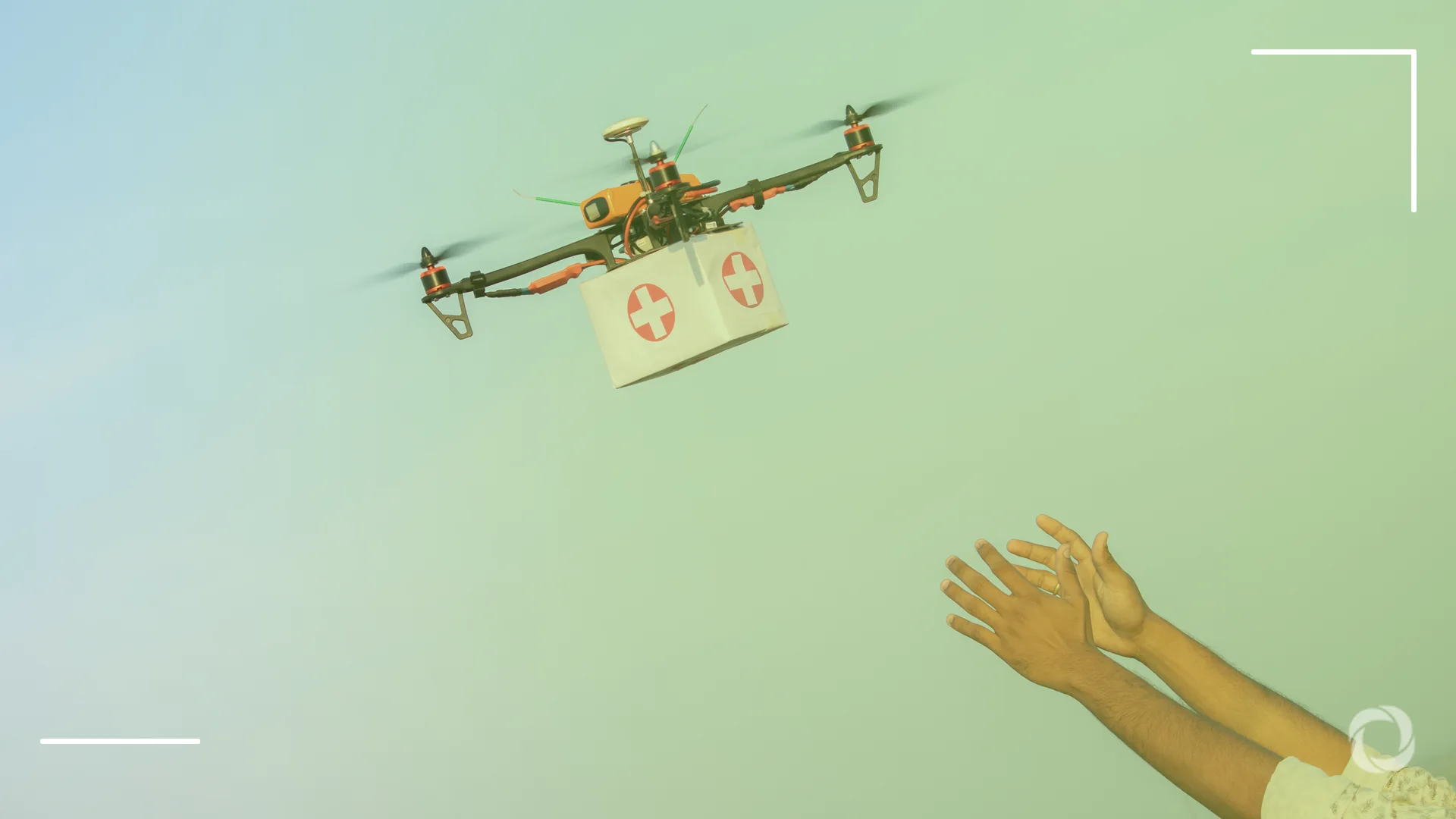
These are aircrafts that fly without a human pilot onboard, are controlled remotely, and follow automated flight routes using onboard systems. In the humanitarian sector, drones are used to map displaced populations to assess needs and to enable aid delivery.
 Blockchain
This is a decentralized digital ledger structure for recording data and transactions across a network of computers and multiple participants. Transactions recorded on blockchain cannot be changed or erased thus ensuring security and transparency without the intervention of a central authority. The decentralized nature of the technology also ensures value transfer between users and decreases transaction costs.
 Module shelters
These are temporary, mobile, and modular shelters developed to provide short-term housing units to support aid workers and populations affected by humanitarian crises, disasters or conflicts. Due to their modular construction technology, they are easily transported and can be installed in a short amount of time.
 Mobile money
Digital financial platforms allow people to send, receive, and store financial units via mobile devices. Such a platform uses a network of agents who operate as cash-in and cash-out points, enabling users to change physical cash to virtual currency and vice versa.
 Predictive analytics
The use of historical data to predict upcoming occurrences and trends can drive strategic actions. The prediction is achieved using machine-learning algorithms or AI and can forecast food shortages, weather events, and disasters.
 Geographic Information Systems (GIS)
A technology system used in analyzing and displaying data geographically, in the humanitarian sector, GIS is utilized to map affected populations, evaluate needs, monitor resources and identify vulnerable areas during emergencies.
HUMTECHs applied by aid organizations in Africa
Blockchain in the humanitarian sector
Blockchain is used to promote openness and effectiveness in the sector’s supply chain. It helps to track the distribution of aid products from donors to vulnerable populations, minimizing diversion and fraud risks. For instance, through Building Blocks, the largest blockchain-centered humanitarian platform, the World Food Programme prevented at least US$270 million in overlapping aid in Ukraine. It was also used to monitor food supply movements from Djibouti port (the facility where WFP receives shipments) to the main location of its food operations in Ethiopia.
Using UAVs for crisis response in Africa
Drones are mainly used in nations such as Mozambique, Rwanda, and Sudan to map huge populations of displaced people, undertake need assessments, and physically deliver humanitarian aid to remote areas. For instance, in Ghana, the government partnered with a private operator –Zipline – to deliver COVID-19 vaccines to remote areas through its four distribution stations that acted as drone airports and medical supply stores. Also, during the Mozambique Cyclone disaster of 2019, flying labs demonstrated effectiveness in drone operations to ensure affected areas were mapped.
NGOs using GIS to address Africa’s humanitarian crises
During climate adaptation initiatives, WFP and NGOs use GIS to map drought-prone regions and forecast food insecurity. GIS also promotes openness and aid transparency. For instance, in Kenya’s 2021-2022 drought, donors used GIS dashboards to track cash transfer initiatives, ensuring that funds reached the most deserving. GIS helps to map crises in a timely manner by integrating satellite images, digital mapping software, and geospatial information.
Temporary dwelling in modular shelters
Shelters are a top priority when a weather disaster or conflict hits a vulnerable community. They provide protection, dignity and durability for displaced households. Prefabricated, modular shelters can be swiftly assembled and can be adjusted or expanded based on the actual needs on the ground. This technological solution enables organisations to provide safer housing in disaster-stricken areas. For instance, Better Shelter, a Swedish-based social enterprise, provides durable and safe module tents for refugees and displaced people in many countries, including the Democratic Republic of Congo, Tanzania, and Ethiopia.
Predictive analysis of anticipated disasters
Predictive analytics are transforming humanitarian actions from being reactive to proactive. Organizations are sending aid before a crisis strikes based on predictive models that suggest the scale of the impact of upcoming events. For instance, the HungerMap by the WFP uses predictive analytics to forecast food insecurity in conflict regions. The HungerMap helps to set priorities and assist the most vulnerable regions first.
Mobile Money promoting cash-based humanitarian programs
Cash-based interventions provide cash to members of communities hit by crises, enabling them to buy goods and services. This method is flexible and empowers recipients while ensuring the speedy and effective release of funds. For example, in 2017, World Vision distributed more than US$13 million through a cash-transfer program to over 346,000 beneficiaries in South Sudan.
Wrap-up
Humanitarian technologies are redefining how aid is planned, delivered, and monitored in Africa. Digital innovations help aid organisations to improve mapping, forecasting, logistics, and emergency housing in areas affected by disasters and conflicts. The use of HUMTECHs ensures timely emergency responses, transparency and data-driven resource allocation.